
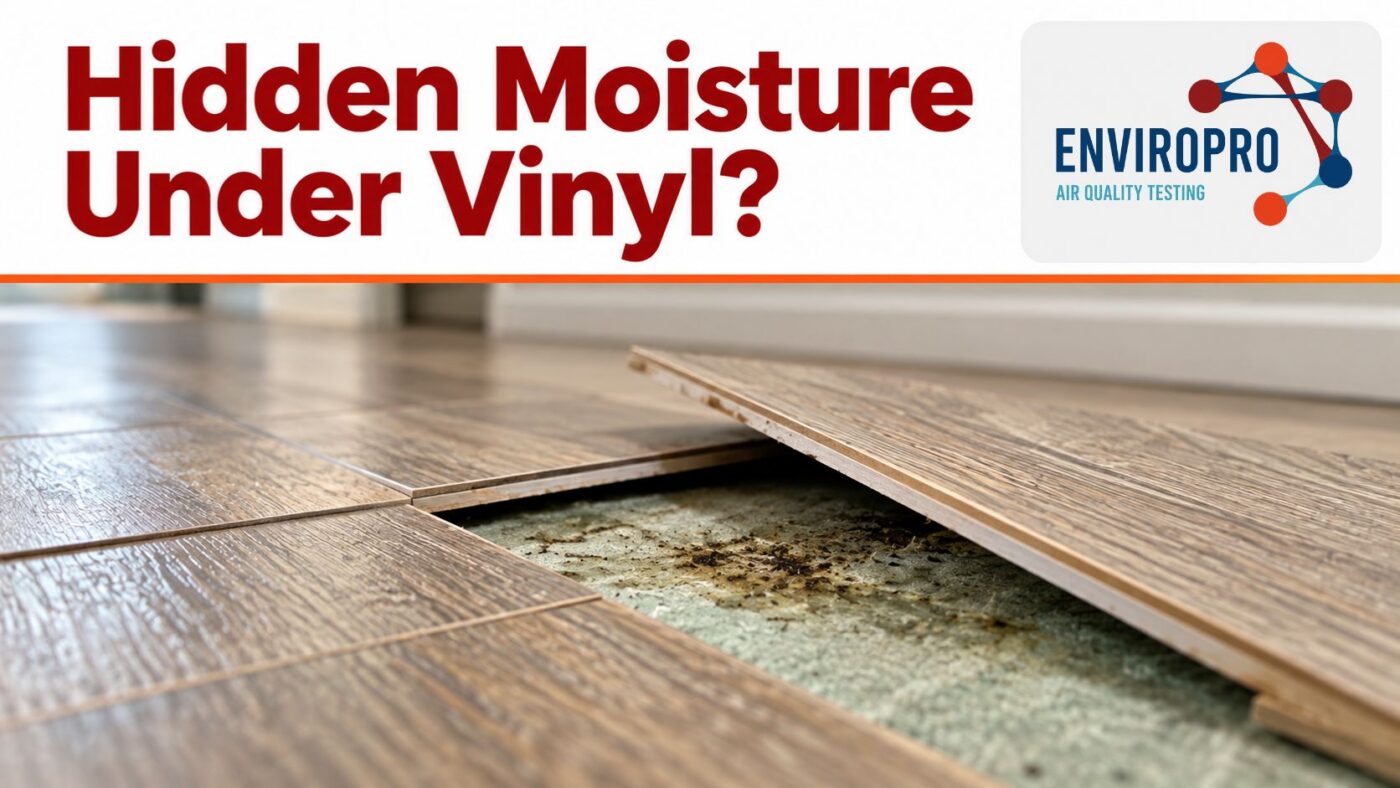
Yes, mold under vinyl plank flooring can develop after a leak when moisture becomes trapped beneath the finished floor and materials that can support growth remain wet. The vinyl plank itself may resist water, but that does not mean the underlayment, plywood, OSB, drywall edges, adhesives, dust, or other material beneath and around it stayed dry.
A leak also does not automatically mean mold developed. How much water entered, where it traveled, how quickly the area dried, and what materials became wet all matter.
Why can mold grow underneath waterproof vinyl?
The word “waterproof” usually refers to the flooring material itself, not to every layer beneath it.
That distinction is central to understanding water under vinyl plank flooring.
Water may reach the underside of an LVP system through:
- Perimeter gaps
- Plank seams
- Doorway transitions
- Plumbing leaks
- Dishwasher or refrigerator lines
- Toilet or vanity leaks
- Water entering from another room
- Moisture coming from the slab or subfloor
Current flooring and restoration references consistently make the same point: the plank may remain visually intact while materials beneath it stay damp.
In short: A waterproof plank is not the same thing as a waterproof floor assembly.
What actually grows mold beneath vinyl flooring?
The vinyl itself is usually not the main food source.
The concern is the material around and underneath it.
Material | Why moisture matters |
Plywood or OSB subfloor | Wood-based material can remain wet beneath LVP |
Cork or other organic underlayment | Can retain moisture |
Drywall paper at wall edges | May wick water from the floor |
Baseboards | Can absorb water |
Dust and debris | May provide organic material |
Certain adhesives or residues | Can contribute to a damp concealed environment |
Concrete slab | Does not itself “feed” mold like wood, but moisture on the slab can affect dust, adhesives, underlayment, walls, or other nearby organic material |
This distinction prevents a common misunderstanding.
If a Las Vegas home has LVP installed over concrete, you should not assume “concrete cannot mold, so there is no problem.” The relevant question is what else is trapped between or adjacent to the slab and finished flooring.
How quickly should a leak be addressed?
As quickly as practical.
The EPA recommends drying damp or water-damaged areas within roughly 24–48 hours to reduce the chance of mold growth.
That does not mean mold definitely appears at a specific hour.
It means you should not wait several days simply because the top of the vinyl looks dry.
After a leak, your priorities are:
- Stop the source of water.
- Remove standing water where it can be accessed safely.
- Determine how far the water traveled.
- Check whether baseboards, drywall, underlayment, or subfloor became wet.
- Dry affected materials appropriately.
- Investigate persistent odor, dampness, or damage rather than covering it back up.
In short: The drying clock applies to what is under the floor, not just what you can see.
How do I know if water is trapped under the vinyl?
You may not see standing water.
Watch for changes around the flooring system.
Possible warning signs include:
- A new musty odor
- Damp baseboards
- Moisture appearing at plank edges
- Flooring that moves differently underfoot
- Soft or swollen areas
- Dark staining near walls
- Persistent dampness around an appliance
- Water squeezing from a seam
- Peeling paint near the bottom of a wall
- A moisture problem that extends beyond the original spill
A musty smell under flooring is not proof of mold on its own, but it is a useful reason to investigate hidden moisture.
Likewise, floor movement does not automatically mean mold. It can result from water-damaged underlayment, subfloor swelling, installation issues, or other causes.
Do you always need to remove vinyl flooring after a leak?
No.
A small spill cleaned immediately from a properly installed floor is different from a dishwasher line that leaked unnoticed for hours or a slow plumbing leak that continued for weeks.
The decision depends on:
- The amount of water
- How long the moisture remained
- Where the water traveled
- Whether the floor is floating or adhered
- Type of underlayment
- Subfloor construction
- Whether contaminated water was involved
- Current moisture readings
- Whether materials can be fully dried
Do not remove a large flooring area merely to “check for mold” without understanding the scope first.
In some situations, targeted access or professional moisture detection may provide useful information before extensive removal.
In short: Investigate the moisture extent first. Flooring removal should solve a specific problem, not be a reflex.
What is different about vinyl over a concrete slab?
This matters in Las Vegas because slab-on-grade construction is common in the region.
Concrete itself can hold and transmit moisture even though it is inorganic. If water becomes trapped between the slab and a flooring system, the concern may involve underlayment, adhesive, dust, baseboards, lower drywall, or other organic material nearby.
A slab can also feel dry at one accessible location while moisture remains elsewhere beneath the floor.
That is why post-leak decisions should rely on actual moisture under LVP conditions rather than assuming either “concrete means no mold” or “a wet slab means the entire floor is contaminated.”
How can professionals check for hidden moisture under flooring?
A water damage mold inspection typically starts with the event itself.
Where did the water come from?
How far could it have moved?
Which materials are likely to have been affected?
An inspector may use material moisture meters, humidity readings, thermal imaging, accessible-edge inspection, visual evidence, and other non-invasive methods to identify areas that warrant closer evaluation.
Enviropro also uses endoscopic camera inspection in appropriate hard-to-see areas.
Thermal imaging can help identify suspicious temperature patterns, but it does not see mold through flooring. Moisture meters likewise measure moisture conditions rather than identifying a fungal species.
That distinction is important.
When does mold testing after a leak make sense?
Mold testing after a leak is most useful when it answers something the inspection alone cannot.
Examples include:
- A musty odor with no visible source
- Concern about airborne spores after hidden water damage
- Suspicious material that requires laboratory identification
- Multiple rooms potentially affected
- A need for documented environmental findings
- Verification after professional mold remediation
If the floor is visibly wet immediately after a fresh leak, however, your first need may simply be water removal and proper drying.
Testing should never delay obvious moisture control.
The CDC notes that mold sampling has limitations and that there are no health-based indoor air standards for mold. Results must therefore be interpreted alongside the actual building conditions rather than treated as a simple pass/fail health score.
Expert takeaway: A laboratory result is one piece of the investigation. Moisture history and physical inspection still matter.
What should a Las Vegas homeowner do after an LVP leak?
A useful decision sequence is:
Fresh, small spill with no evidence water entered below:
Dry it immediately and monitor the surrounding area.
Known water underneath the planks:
Determine the affected extent and whether the underlayment or subfloor can be dried.
Leak was hidden, or duration is unknown:
Consider professional moisture evaluation.
Musty odor or suspicious damage develops later:
Investigate for hidden mold under flooring and residual moisture.
Water came from a contaminated source:
Treat the situation differently from a clean-water spill and involve an appropriate water-damage professional.
If mold remediation becomes necessary, testing and remediation are separate functions. Enviropro’s role is to evaluate and test environmental conditions rather than make assumptions based on the floor’s appearance.
Frequently Asked Questions
Yes. Mold can grow on damp organic materials underneath or adjacent to LVP when water becomes trapped and materials remain wet.
Warning signs can include moisture at seams, damp baseboards, soft areas, floor movement, staining, or a musty odor. Moisture measurements can provide better information when the condition is hidden.
No. Water-resistant or waterproof planks protect the plank itself, but they cannot guarantee that water never reaches the surrounding floor assembly.
Not automatically. The decision depends on how much water entered, what lies beneath the planks, whether materials remain wet, and whether drying is possible.
The process usually begins with a moisture investigation. When laboratory testing is useful, an inspector may collect appropriately selected air or surface samples based on what the inspection finds.
Mold does not need to grow on the concrete itself. Moisture on or above a slab can support growth on dust, underlayment, adhesives, drywall paper, baseboards, or other nearby organic materials.
A dry-looking vinyl floor does not prove everything underneath is dry
After a leak, mold under vinyl plank flooring is possible, but it is not inevitable.
The practical question is whether water reached moisture-sensitive material and whether that material dried.
If your Las Vegas property has had a plumbing leak, appliance leak, or other water event and you are unsure what remains beneath the flooring, Enviropro Mold & Mycotoxin Testing can perform a moisture-focused inspection and recommend targeted testing when the findings justify it.
