
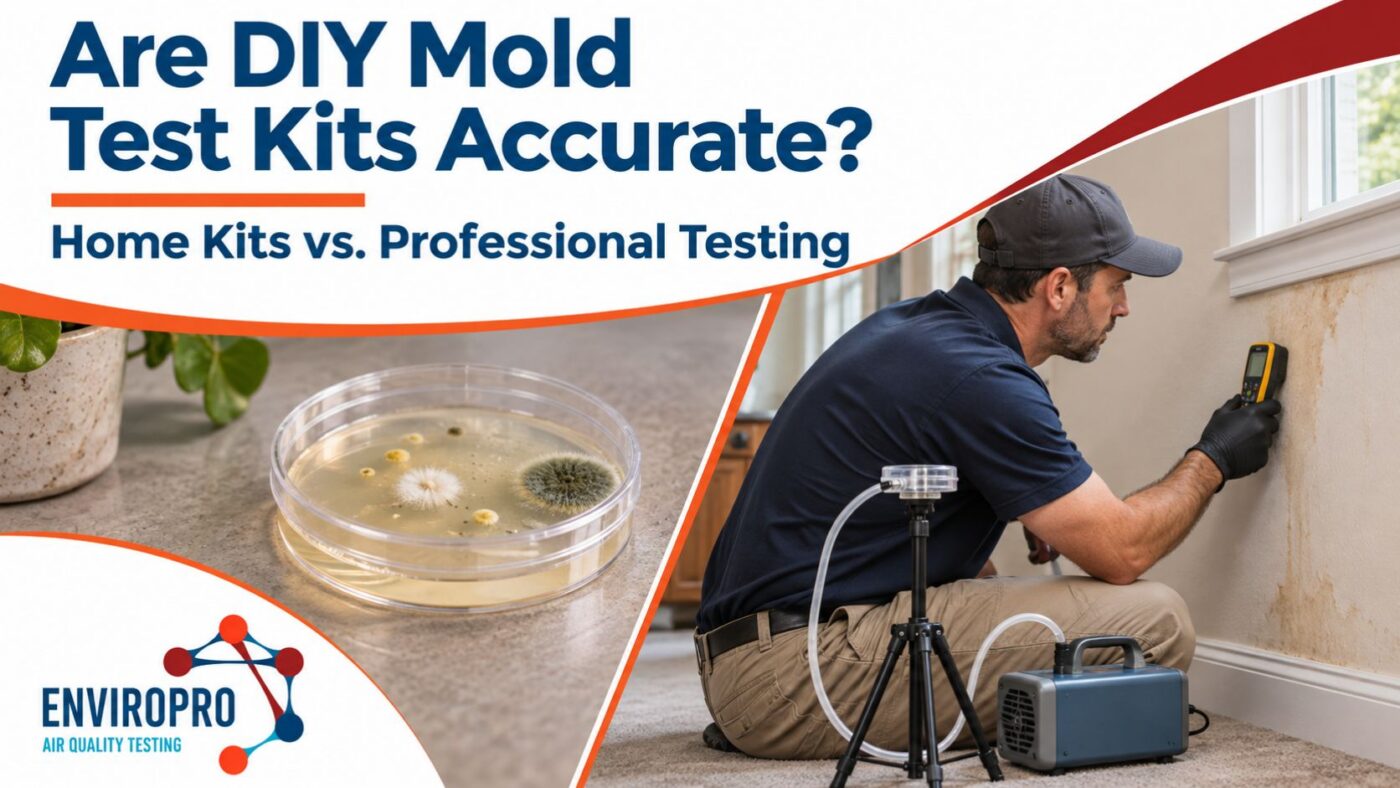
Are DIY mold test kits accurate? Some kits can detect or identify mold in a collected sample, but that doesn’t mean they can reliably determine whether your home has a significant mold problem. Many inexpensive kits simply show that mold spores are present, which is normal in indoor environments. Professional mold testing can provide more useful information when sampling is appropriate because it combines an inspection, moisture investigation, laboratory analysis, and interpretation of the results.
Before purchasing a kit or scheduling an inspection, it’s worth understanding what each option can actually tell you.
How Do DIY Mold Test Kits Work?
Most home mold test kits fall into three categories.
Petri Dish Mold Test Kits
These kits contain a prepared culture plate that is exposed to indoor air or receives material from a surface.
After a period of incubation, visible colonies may develop on the plate.
The problem is that mold spores are naturally present in indoor and outdoor air. Given favorable growing conditions, some of those spores can develop into visible colonies.
Finding mold on a petri dish doesn’t necessarily mean your home has an unusual indoor mold problem.
The number or appearance of colonies also cannot reliably establish how much mold is circulating throughout a room.
Surface Swab and Tape-Lift Kits
Surface kits collect material from a specific location, such as a discolored wall or suspicious area near a window.
When properly collected and analyzed by a qualified laboratory, these samples can help identify mold present on that surface.
However, a surface result cannot tell you whether mold is growing behind a wall or whether airborne spore concentrations are unusual elsewhere in the home.
It answers a question about the sampled material, not the entire property.
DIY Air Sampling Kits
Some consumer kits include equipment for collecting airborne particles and sending samples to a laboratory.
These can produce more detailed information than a simple culture plate, depending on the equipment, collection procedure, and laboratory method.
Still, the results represent the air collected at a particular location and time.
Sampling conditions, air movement, occupant activity, and the availability of a suitable comparison sample can all affect interpretation.
A laboratory report is useful only when it answers the right question.
Why Can DIY Mold Test Results Be Misleading?
The biggest problem with many DIY kits isn’t necessarily that they fail to detect mold.
It’s that detecting mold doesn’t automatically establish that something is wrong.
Mold Spores Are Already Present in the Environment
Mold spores travel through outdoor air and enter buildings through doors, windows, ventilation, and everyday activity.
A positive result from a consumer kit may reflect ordinary environmental spores rather than mold actively growing inside the home.
A Positive Result Doesn’t Identify the Source
Suppose a petri dish develops several colonies after being left in a bedroom.
That result doesn’t establish whether spores came from outside, settled dust, or a damp area behind drywall.
It also doesn’t show where a moisture problem might exist.
A Negative Result Doesn’t Rule Out Hidden Mold
A test can miss a problem if mold is growing inside an enclosed wall cavity or beneath flooring and isn’t releasing detectable material into the sampled area at that moment.
Hidden mold investigations need to consider moisture conditions, odors, water damage, and building materials.
Results Cannot Diagnose Health Risks
There is no federal health-based standard that defines a single safe or unsafe indoor mold spore concentration for every person.
A mold test cannot diagnose illness or establish that a particular individual’s symptoms were caused by mold.
People with persistent respiratory symptoms or other health concerns should speak with an appropriate healthcare professional.
DIY Mold Test Kits vs. Professional Mold Testing
Feature | DIY Mold Test Kits | Professional Mold Testing |
Initial cost | Usually lower | Higher, depending on property and scope |
Sample collection | Completed by homeowner | Planned and performed by an inspector |
Moisture investigation | Usually not included | May include moisture and humidity measurements |
Hidden mold assessment | Limited | Can investigate concealed moisture conditions |
Laboratory analysis | Depends on the kit | Used when sampling is appropriate |
Result interpretation | Often limited | Considers building conditions and inspection findings |
Best use | Narrow questions about accessible samples | Complex, hidden, recurring, or documented moisture concerns |
Professional testing isn’t automatically necessary in every situation, and a professional sample isn’t automatically more meaningful simply because it costs more.
The advantage of a professional assessment is having someone investigate the building and decide whether sampling will provide useful information.
What Makes Professional Mold Testing Different?
A professional mold inspection generally starts with a question about the property.
Has there been a plumbing leak? Is there a persistent musty smell? Did a ceiling stain appear after an air-conditioning problem?
The answers determine where to investigate.
Visual Inspection and Moisture Detection
An inspector looks for damp materials, water staining, visible growth, and evidence of unresolved moisture.
Moisture meters and humidity readings help determine whether building materials or indoor conditions require closer attention.
Thermal imaging may reveal temperature patterns associated with possible moisture, but the camera itself cannot identify mold.
Air and Surface Sampling When Appropriate
If additional information is needed, an inspector may collect targeted air or surface samples.
Outdoor comparison samples can sometimes help interpret indoor airborne spore patterns, although no single comparison or sample establishes whether a home is medically safe.
Laboratory results should always be considered alongside the property conditions.
Reports That Explain the Findings
A useful mold assessment explains what was observed, what was sampled, the limitations of the testing, and what actions may be appropriate.
For example, identifying a continuing plumbing leak may be more immediately important than obtaining the name of every mold found near the leak.
Testing should support practical decisions, not replace them.
When Is a DIY Mold Test Kit Enough?
A DIY kit may be useful when you want limited information about material on a particular accessible surface and understand what the results cannot prove.
But you may not need testing at all.
If a small area of visible mold has an obvious moisture source, repairing that source and cleaning the affected material appropriately may be the most useful next step.
The EPA advises that sampling is generally unnecessary when visible mold growth is already present.
More extensive contamination, contaminated water, significant damage, or conditions involving vulnerable occupants may require professional assistance.
When Should You Hire a Professional Mold Inspector?
Consider a professional mold assessment when:
- A musty odor persists, but there is no visible source.
- A property has experienced significant or recurring water damage.
- Flooring, drywall, or insulation may contain hidden moisture.
- Mold-like discoloration returns after cleaning.
- Several rooms show suspicious moisture conditions.
- Documentation is needed for a property-related decision.
- You need verification following professional mold remediation.
For a Las Vegas homeowner, an example might be a bathroom wall that repeatedly develops stains despite repairs.
Buying several petri dish kits won’t identify a hidden pipe leak. A moisture-focused inspection is more likely to help locate the cause.
How Much Does DIY Testing Cost Compared With Professional Testing?
DIY testing usually costs less upfront, but the total expense depends on the method.
Some kits require additional laboratory fees. Testing multiple rooms may also require additional kits.
Professional mold testing costs depend on property size, the number of areas requiring inspection, the sampling plan, and the type of laboratory analysis.
Rather than comparing prices alone, ask what information you will receive.
Before scheduling professional testing, consider asking:
- Does the price include a moisture inspection?
- How many samples are included, if any?
- Are laboratory fees included?
- Will the report explain the findings?
- Can the inspector explain whether sampling is necessary?
These questions help ensure that you’re purchasing an assessment suited to your actual concern.
Frequently Asked Questions
Some work for detecting mold in collected material. However, detecting mold doesn't establish whether there is abnormal indoor growth, where a hidden source is located, or whether indoor air presents a health risk.
Petri dishes can grow mold from ordinary environmental spores, making the results difficult to interpret. They are generally not a reliable way to assess whether a building has a significant indoor mold problem.
Not reliably. A sample collected in a room may not represent conditions inside a wall cavity. Investigating suspected hidden mold usually requires examining moisture conditions and the affected building materials.
Not always. Visible mold generally needs appropriate cleanup and moisture correction rather than testing simply to prove it exists. Professional assessment can still be useful when the damage is extensive, or the source is uncertain.
No individual mold test can guarantee that a home is safe or free from health risks. Results must be interpreted in context, and they cannot predict an individual's medical response.
Get Clear Answers With Professional Mold Testing in Las Vegas
A low-cost mold kit may answer a narrow question, but it can also create confusion when the result isn’t interpreted correctly.
If you’re dealing with a persistent musty odor, hidden moisture, recurring stains, or suspected mold after water damage, Enviropro Mold & Mycotoxin Testing provides professional mold inspections and targeted testing throughout Las Vegas and surrounding areas.
Our services include moisture detection, thermal imaging, air and surface sampling, laboratory analysis, and detailed reporting based on the property’s conditions.
Request Pricing & Availability or Schedule a Mold Inspection through Enviropro’s contact page. You can also call (702) 308-3524 to discuss your concerns.
