
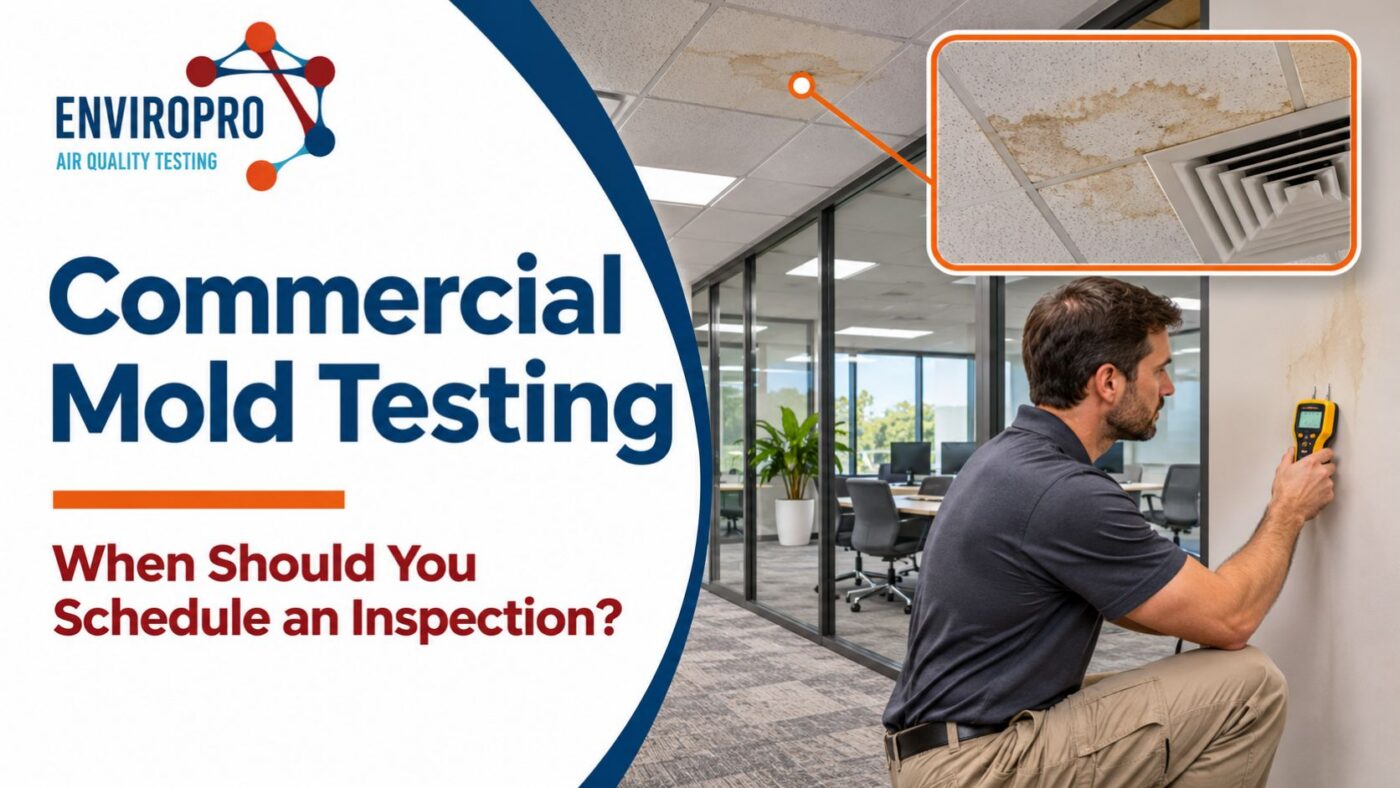
Commercial mold testing is worth considering when a business property has unresolved water damage, persistent musty odors, suspected hidden mold, or recurring moisture problems. An inspection can help business owners and property managers understand the condition of affected areas and decide whether laboratory sampling is useful. However, not every building needs routine mold testing. The priority is identifying and correcting moisture problems before they spread.
For businesses in Las Vegas, that means paying attention to more than obvious stains on the walls. HVAC equipment, roof drainage, plumbing systems, and concealed building materials can all contribute to indoor moisture problems.
Why Does Commercial Mold Testing Matter?
Commercial buildings often have more complicated moisture and ventilation systems than individual homes.
A leak above a suspended ceiling can affect several offices. A blocked air-conditioning condensate drain may damage nearby insulation and drywall. Water from a restroom or breakroom can travel beneath flooring into adjoining spaces.
These problems may remain hidden while employees, customers, or tenants continue using the property.
Mold growth can damage building materials and may contribute to allergic reactions, irritation, or asthma symptoms in sensitive individuals.
A commercial mold inspection helps determine where moisture is occurring, which materials may be affected, and whether further evaluation is needed.
It also creates documentation that can support maintenance planning and communication between property owners, tenants, and contractors.
Six Signs Your Business May Need a Mold Inspection
1. A Persistent Musty Odor
An earthy or musty smell in a conference room, hallway, storage area, or office may suggest a moisture problem.
This is especially worth investigating when the smell returns after cleaning or is concentrated near a wall, ceiling, or air-conditioning system.
Odor alone doesn’t confirm mold. However, it is a useful reason to check for concealed moisture.
2. Recurring Water Leaks
Repeated roof leaks, leaking pipes, overflowing sinks, and poorly draining HVAC systems create conditions that can support mold growth.
Even when the visible water has been removed, moisture can remain inside drywall, insulation, flooring, and ceiling assemblies.
If an area has experienced multiple leaks, a professional moisture assessment can help determine whether the damage extends beyond what is visible.
3. Water Stains or Damaged Building Materials
Watch for ceiling discoloration, peeling paint, swollen baseboards, deteriorating drywall, or soft flooring.
These conditions don’t automatically mean mold is present. They do indicate that the affected materials deserve closer inspection.
A freshly painted ceiling, for example, doesn’t prove that the underlying leak was corrected.
4. Moisture Around HVAC Equipment
Air-conditioning systems deserve particular attention in Las Vegas commercial properties.
Condensation is a normal part of cooling, but it should be collected and drained correctly.
Blocked condensate lines, standing water in drip pans, damaged insulation, and poorly maintained components can introduce moisture into building materials.
An HVAC technician may need to correct the equipment problem, while a mold inspector can help evaluate affected environmental conditions.
5. Repeated Employee or Tenant Complaints
If several people report musty odors, visible dampness, or concerns about a specific area, management should investigate the building conditions.
Health complaints should be taken seriously without assuming that mold is necessarily the cause.
A building inspection can identify moisture-related concerns, while medical questions should be addressed by healthcare professionals.
6. Previous Mold Remediation
Following a remediation project, a post-remediation assessment can help determine whether the affected area meets the agreed cleanup criteria.
This may involve checking the corrected moisture source, inspecting cleaned surfaces, and performing targeted sampling when appropriate.
Verification is particularly useful before concealed areas are rebuilt or returned to normal use.
When Should Commercial Mold Testing Be Scheduled?
Different circumstances call for different responses.
Situation | Recommended action |
Active plumbing or roof leak | Stop water intrusion and arrange prompt drying |
Damp materials remain after a leak | Schedule a moisture-focused inspection |
Persistent musty odor with no visible source | Investigate for hidden moisture or mold |
Visible mold growth | Address the moisture source and plan appropriate cleanup |
Recurring HVAC condensation | Arrange HVAC maintenance and assess affected materials |
Completed professional mold remediation | Consider post-remediation verification |
No odors, leaks, damage, or related concerns | Prioritize routine building maintenance rather than automatic mold sampling |
The EPA recommends drying wet building materials within 24–48 hours to reduce the likelihood of mold growth.
That guidance is particularly relevant for commercial properties where water may travel through connected walls, ceiling spaces, or multiple occupied units.
What Happens During a Commercial Mold Inspection?
An effective inspection should reflect how the property is used, where moisture problems have occurred, and which areas are accessible.
Reviewing the Building’s Moisture History
The inspector may ask about previous leaks, roof repairs, HVAC maintenance, plumbing failures, occupant complaints, and earlier remediation.
Maintenance logs and photographs can provide important clues about where to begin.
Inspecting High-Risk Areas
Depending on the property, an inspection may focus on restrooms, breakrooms, ceiling spaces, HVAC-adjacent areas, storage rooms, and locations affected by prior leaks.
Accessible building materials are checked for visible growth, staining, dampness, and deterioration.
Measuring Moisture and Humidity
Moisture meters and hygrometers help identify conditions that warrant additional investigation.
Thermal imaging may reveal unusual temperature patterns associated with moisture, but it cannot identify mold directly.
Collecting Samples When Needed
Some investigations benefit from air or surface samples analyzed by a laboratory.
For example, targeted sampling may be appropriate when suspicious material needs identification or when a sampling protocol is part of a defined investigation.
However, routine air testing isn’t recommended as a substitute for evaluating the building itself.
The CDC’s National Institute for Occupational Safety and Health emphasizes visual inspections, moisture evidence, and mold-related odors because short-term air samples have important limitations.
Reviewing the Findings
A useful report should explain the areas evaluated, relevant moisture findings, sampling results if collected, and recommended next steps.
No single airborne mold number can establish that a commercial property is universally safe or unsafe.
Is Commercial Mold Testing Required by Law?
There is no universal federal requirement for every commercial property to undergo mold testing on a fixed schedule.
OSHA provides guidance on mold prevention and building maintenance, but its general mold guidance does not create a mandatory routine mold-sampling program.
Specific responsibilities may depend on workplace conditions, applicable building and occupational safety rules, lease provisions, insurance requirements, and the property’s use.
Business owners should not assume that a generic laboratory report establishes regulatory compliance.
When legal or contractual requirements are involved, consult the appropriate professional.
What Should Business Owners Do Before an Inspection?
A little preparation can make the evaluation more useful.
Start by gathering the property’s water-damage history. Identify recurring problem areas and ask maintenance personnel about leaks, odors, or repairs.
Make a list of the areas that need investigation and provide access to relevant rooms or maintenance spaces when authorized.
If the business leases its space, coordinate with the landlord or property manager before arranging work involving shared systems or restricted building areas.
Don’t paint over suspicious growth, remove affected materials unnecessarily, or disturb potentially contaminated spaces simply to prepare for testing.
If water is actively entering the building, deal with the source immediately.
How Can Commercial Properties Reduce Future Mold Problems?
Mold prevention begins with consistent moisture management.
Business owners and facility managers should prioritize regular roof and plumbing maintenance, proper HVAC drainage, functioning ventilation, and quick responses to water intrusion.
It also helps to document recurring leaks and verify that affected materials are dry before completing repairs.
After remediation, keep the original findings and follow-up records together. They can help future maintenance teams understand the property’s history.
These steps are often more valuable than repeatedly collecting air samples without a clear reason.
Frequently Asked Questions
There is no universal testing frequency for every commercial building. Inspections should be driven by moisture concerns, visible conditions, building history, and relevant contractual or operational requirements.
Yes. Mold can develop on damp components or materials when suitable conditions exist. Inspecting drainage, moisture, and accessible HVAC components helps determine whether a problem requires attention.
A leak should be repaired and affected materials dried promptly. Further inspection is appropriate if water damage is extensive, drying is uncertain, or suspicious odors and material damage remain.
It depends on the size and layout of the building, access to affected areas, the complexity of the moisture problem, and whether sampling is necessary. Request a property-specific estimate before scheduling.
No. A mold assessment provides information about conditions observed and samples collected. It cannot guarantee the absence of all mold, future moisture problems, or individual health risks.
Schedule Commercial Mold Testing in Las Vegas
Whether you manage an office, retail location, or another commercial property, unresolved moisture problems deserve careful attention.
Enviropro Mold & Mycotoxin Testing provides commercial mold inspections in Las Vegas, Nevada, with moisture detection, thermal imaging, professional sampling when appropriate, and laboratory-based reporting.
Our goal is to help property owners and facility managers understand the findings and make informed decisions about the next steps.
Schedule a Mold Inspection or Request Pricing & Availability at testingbyenviropro.com/contact-us. Call (702) 308-3524 to discuss your commercial property’s inspection needs.
