
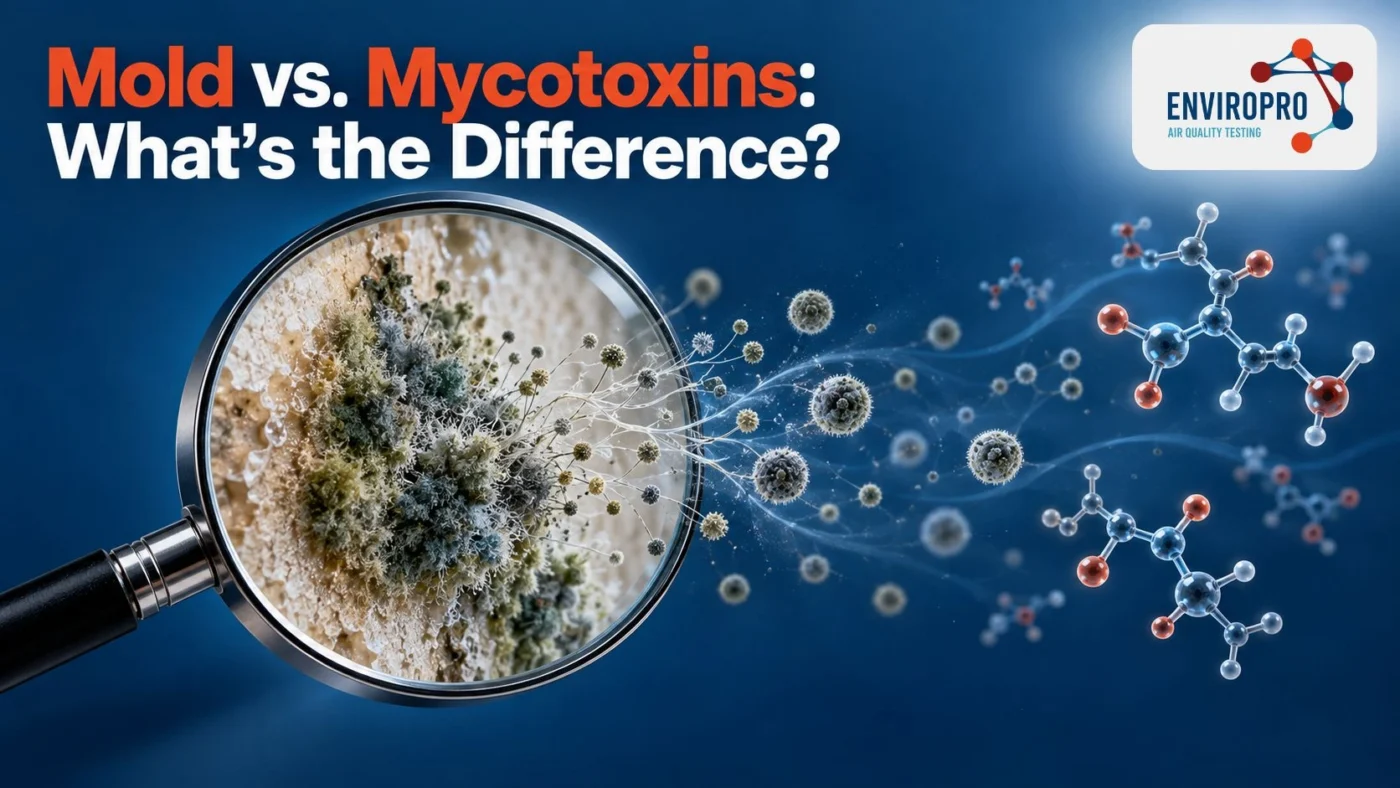
The basic mold vs mycotoxins difference is simple: mold is a living fungus that grows on damp material, while mycotoxins are chemical compounds that certain molds may produce under certain conditions. Mold spores help the organism reproduce and spread; mycotoxins are not spores, are not alive, and are not produced by every mold problem.
Mold vs mycotoxins at a glance
This side-by-side comparison shows where the terms separate.
|
Feature |
Mold |
Mold spores |
Mycotoxins |
|
What it is |
Fungal growth made of branching structures called hyphae |
Microscopic biological particles used by mold to reproduce and disperse |
Chemical compounds that some molds can produce |
|
Why it is found indoors |
Spores land on damp material and begin growing |
Spores enter from outdoors or are released from indoor growth |
Certain molds may produce them when biological and environmental conditions support production |
|
Can you see it? |
Established colonies may become visible |
Usually not without magnification |
No |
|
Can color identify it? |
No; many molds share similar colors |
No |
No |
|
Common environmental evaluation |
Visual inspection, moisture assessment, and targeted sampling when useful |
Air or surface sampling with laboratory analysis |
Specialized collection and laboratory analysis for selected compounds |
|
What a positive finding means |
Growth or fungal material was observed or detected |
Spores were found in that sample |
A targeted compound was detected in that sample |
|
What it does not prove |
That mycotoxins are present, or a symptom was caused by the property |
That the mold was actively producing mycotoxins |
A medical diagnosis, source attribution, or universal level of health risk |
In short: What is the difference between mold and mycotoxins? Mold is the organism; spores are reproductive particles; mycotoxins are possible chemical products of some molds.
What is mold, and what are mold spores?
Mold is a type of fungus found throughout the natural environment. Outdoors, it helps break down organic matter; indoors, it becomes a building concern when it grows on wet materials such as drywall paper, wood, carpet backing, insulation, dust, or fabric.
Mold reproduces through microscopic spores. These particles are common in both indoor and outdoor air, so the goal of a property assessment is not to prove that every spore has been eliminated.
The practical question is whether moisture is supporting indoor mold growth or whether the distribution of spores and growth indicates an indoor source. That is why inspectors look at leaks, staining, humidity, material conditions, odors, and the history of water events instead of relying on one air sample alone.
In short: Mold is a fungal colony growing on material. Spores are particles that can spread from that growth or enter naturally from outdoors.
What are mycotoxins?
Mycotoxins are naturally occurring compounds made by certain fungi. They are sometimes called secondary metabolites because they are chemicals produced during fungal activity rather than structures needed to form the mold itself.
Not every mold species can produce them. Even a toxigenic mold, meaning a mold capable of toxin production, may not produce the same compounds in every location or at every stage of growth.
Production depends on both the organism and its surroundings. Moisture, temperature, nutrients, the affected material, competing organisms, and other conditions can influence what a colony produces.
This is the key to understanding mold and mycotoxins: capability is not the same as confirmed production. A mold name on a laboratory report does not automatically establish which toxins, if any, were present in the property.
Can mold be present without mycotoxins?
Yes. Does all mold produce mycotoxins? No. Many molds do not have that capability, and capable types do not necessarily produce toxins under every condition.
The reverse situation also needs context. A targeted chemical may be detected in settled dust or on material even when active growth is not obvious at the sampling point. That result could raise a useful environmental question, but it does not identify the source or timing on its own.
A responsible interpretation separates four findings:
- A moisture condition exists.
- Mold growth or fungal material is present.
- A type capable of toxin production was identified.
- A specific mycotoxin was detected in a selected sample.
Each finding adds information, but none should be treated as a substitute for the others.
In short: Mold can exist without mycotoxins, and a chemical detection needs property context before it can guide a decision.
Can you identify mycotoxins by color or smell?
No. Can you see or smell mycotoxins? You cannot reliably detect them with your senses.
A musty smell may point to moisture or microbial growth, but the odor does not identify mycotoxins. Mold odors often come from volatile compounds released during microbial activity, and those compounds are not automatically toxins.
Color is also a poor guide. “Black mold” is a popular label, not a chemical test, and dark-colored growth is not proof of toxin production.
Does black mold always contain mycotoxins? No. Some strains of Stachybotrys chartarum and other molds may be capable of producing particular compounds, but appearance alone cannot confirm species, strain, or active production.
In short: Use color and odor as reasons to investigate moisture, not as evidence that mycotoxins are present.
Mold exposure and mycotoxin exposure are not the same claim
Mold exposure can involve spores, fragments, allergens, irritants, odors, and other materials found in a damp indoor environment. Public-health agencies recognize associations between damp or moldy buildings and allergic or respiratory effects in some people, while responses vary among individuals.
Mycotoxin exposure is a narrower claim involving contact with specific fungal compounds. The health effects of certain mycotoxins are well established in food and occupational contexts, but interpreting possible exposure from a residential indoor sample is less straightforward.
There are no federal health-based standards for mold concentrations in indoor air. Research also notes that collection methods, laboratory methods, and interpretation of indoor mold and mycotoxin samples are not fully standardized.
This means an environmental result should not be used as a diagnosis. It cannot prove that a building caused headaches, fatigue, respiratory complaints, or another medical condition.
If symptoms are part of the concern, take two separate steps: have the property evaluated by a qualified environmental professional and discuss the symptoms with a licensed healthcare provider. Neither professional should pretend to do the other’s job.
How mold testing differs from mycotoxin testing
Mold testing usually evaluates fungal spores or material collected from indoor air or a surface. Depending on the method, a laboratory may identify broad categories or genera and report concentrations or relative abundance.
Mycotoxin testing targets selected chemical compounds using a different collection and analytical process. It is not automatically included in an ordinary mold air or surface test.
Is mold testing the same as mycotoxin testing? No. The choice should be based on the property question:
- “Is there a hidden moisture source?” Start with a mold inspection and moisture assessment.
- “Are indoor spore patterns different from outdoors?” A planned set of indoor and outdoor air samples may provide context.
- “What is growing on this material?” Targeted surface sampling may help identify fungal material.
- “Was a selected fungal compound detected in this dust or material?” That requires specialized analysis.
- “Did this building cause my symptoms?” Neither environmental test can answer that medical question by itself.
Short-term samples represent a limited place and time. Results should be interpreted with visual findings, moisture readings, ventilation conditions, occupant observations, and the location where each sample was collected.
Expert tip: Before paying for laboratory work, ask the inspector what decision will change based on the result. If the answer is vague, the sample may not be necessary.
When is testing useful, and when can you skip it?
Testing is most useful when it resolves uncertainty. It should not be added simply because a long list of tests sounds more thorough.
When is mycotoxin testing useful? It may be worth discussing when a property has substantial or repeated moisture damage, the investigation has a clearly defined question about selected compounds, or earlier findings do not explain a specific environmental concern.
A professional assessment may also be useful when:
- Growth may be concealed behind walls, flooring, ceilings, or cabinetry
- Musty odors persist without an obvious source
- A real estate or property-management decision requires documentation
- The extent of contamination is unclear
- A post-remediation plan calls for independent verification
Testing may be unnecessary when visible mold already establishes the need to repair moisture and remove contaminated material. Federal guidance notes that routine sampling is often not needed when mold growth is plainly visible because the moisture problem and growth still need to be addressed.
In short: Inspect first, define the question second, and sample only when the result will guide an actual property decision.
What Las Vegas property owners should do next
The desert climate does not eliminate indoor moisture problems. Plumbing leaks, HVAC condensation, roof damage, appliance failures, and water trapped beneath flooring or behind drywall can support localized growth inside Las Vegas homes and commercial properties.
If you notice staining, a persistent odor, or a history of leaks, follow this sequence:
- Stop active water intrusion.
- Document when and where the problem appeared.
- Avoid opening walls or disturbing extensive growth without a plan.
- Schedule a Las Vegas mold inspection focused on moisture and building conditions.
- Use indoor air quality testing or surface samples only when they address a defined question.
- Discuss mycotoxin testing Las Vegas options only if specialized analysis is relevant to that investigation.
- Correct the moisture source and arrange appropriate cleanup, regardless of whether a toxin test is performed.
Enviropro Mold & Mycotoxin Testing provides inspections, moisture readings, thermal imaging, air and surface sampling, laboratory reporting, and mold testing Las Vegas property owners can use to clarify building conditions. Same-day scheduling may be available, but the recommended scope should still depend on the property rather than a preset testing package.
Frequently Asked Questions
Mold is a fungus that can grow on damp material. Mycotoxins are chemical compounds that certain molds may produce under certain biological and environmental conditions.
No. The mold spores vs mycotoxins comparison involves two different types of material: spores are biological reproductive particles, while mycotoxins are chemical compounds. They also require different analytical approaches.
No. Mold growth confirms a moisture-related fungal problem, but it does not demonstrate that the mold is capable of producing toxins or that toxins were produced in that location.
A standard mold-spore air test does not automatically test for mycotoxins. Specialized collection and laboratory analysis are needed for the compounds included in the requested panel.
No. An environmental test can report what was detected in a property sample. It cannot diagnose a person, establish a dose, or prove that a symptom was caused by the building.
Not always. If growth is visible, repairing the moisture source and arranging appropriate removal may be the immediate priorities. Testing is more useful when it will identify an uncertain source, define the scope, document conditions, or support verification after cleanup.
Start with a property inspection that reviews leak history, odors, visible conditions, moisture readings, and concealed areas where appropriate. Select samples after the inspector identifies the specific question each one should answer.
Get the right test for the right question.
The practical mold vs mycotoxins distinction is not about deciding which term sounds more dangerous. It is about identifying what exists in the building, what remains uncertain, and which inspection or laboratory method can answer that question without making claims the evidence cannot support.
If your Las Vegas property has recent water damage, unexplained odors, visible growth, or suspected hidden moisture, contact Enviropro Mold & Mycotoxin Testing.
