
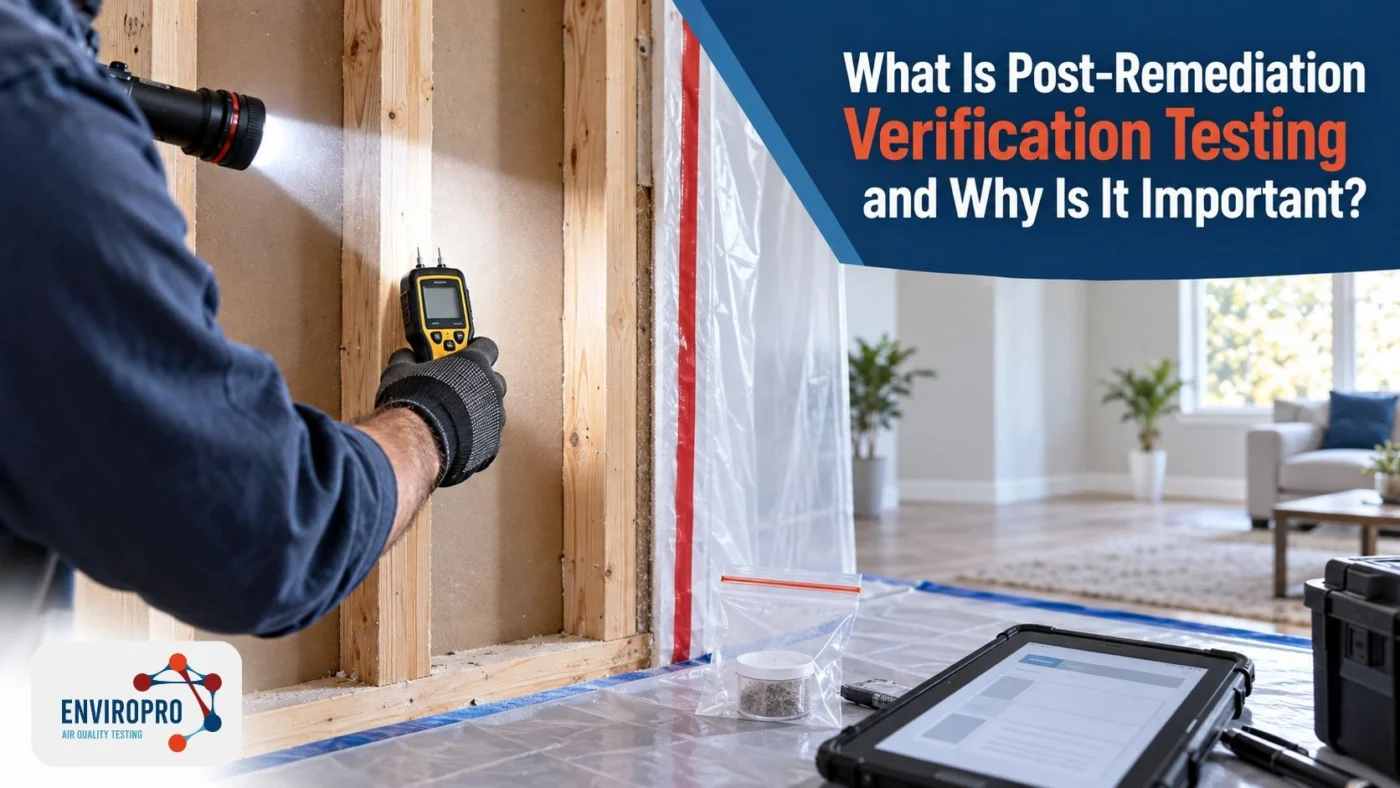
Post-remediation verification testing is an evaluation performed after mold cleanup to determine whether the work area meets the project’s agreed completion criteria. It may combine a visual inspection, moisture measurements, and targeted air or surface sampling; it does not guarantee that a property is mold-free, permanently dry, or free of every health risk.
What does post-remediation verification testing check?
The purpose is to answer a narrow, useful question: did the remediated area meet the conditions established for closing this cleanup project?
A typical post-remediation mold inspection considers whether:
- The leak, condensation issue, or other moisture source was corrected
- Removed materials and cleaned surfaces match the remediation scope
- No visible mold, suspect growth, settled dust, or remediation debris remains in the work area
- Materials that are supposed to remain are dry
- Musty or mold-related odors are absent
- Containment and pressure controls, if used, have protected adjacent areas
- Sampling results, when sampling is appropriate, meet the project’s written criteria
The U.S. Environmental Protection Agency says a remediation project is not complete until the moisture problem has been fixed, cleanup is finished, and visible mold, mold-damaged materials, and moldy odors are absent. It also describes final judgment as a combination of observations rather than a single automatic number.
That distinction matters because there is no federal airborne mold concentration that separates every acceptable building from every unacceptable one. The criteria should fit the original findings, the remediation plan, the building, and the sampling method.
In short: Mold remediation verification checks whether the defined cleanup goals were met. It is not a universal certificate of health or a promise that mold can never return.
Initial inspection, remediation, and mold clearance testing are different jobs
These terms describe three stages of one project. Confusing them can lead to gaps, such as testing before a moisture source is found or rebuilding before cleanup has been checked.
|
Stage |
Main question |
Typical work |
Typical result |
|
Initial mold inspection |
Where is the moisture or suspected growth, and how far might it extend? |
History, visual review, moisture readings, thermal imaging, and targeted sampling when it can answer a defined question |
Findings and recommendations or a remediation scope |
|
Mold remediation |
How will affected materials be removed or cleaned while controlling dust and debris? |
Containment, removal, cleaning, drying, and correction of contributing conditions |
A work area ready for evaluation |
|
Mold clearance testing |
Did the completed work meet the project criteria? |
Visual and moisture review, plus air or surface sampling when warranted |
A post-remediation report documenting acceptance or needed corrections |
The remediation contractor performs the cleanup. The person conducting the clearance inspection evaluates the result against the scope and protocol. Finish reconstruction should wait until the area has met the applicable criteria.
In short: Inspection defines the problem, remediation addresses it, and verification checks the completed work.
When should PRV testing be performed?
Schedule verification after the remediator says cleaning and drying are complete, but before the work area is returned to normal use or covered by reconstruction. If the project uses containment, ask the evaluator whether barriers and air-control equipment should remain operating until the assessment and any sampling are complete.
The exact timing depends on the written protocol. Recent cleaning activity can disturb particles, while shutting equipment down or removing containment too early can change conditions before the evaluator arrives.
A practical scheduling sequence is:
- The remediator completes removal, detailed cleaning, and drying.
- The moisture source and necessary repairs are confirmed.
- The work area is left in the condition required by the verification protocol.
- The evaluator performs the site review and any planned sampling.
- The laboratory reports results, if samples were collected.
- The evaluator issues findings before reconstruction proceeds.
Do not wait until new drywall, cabinets, or flooring conceal the cleaned surfaces. A later inspection may not be able to evaluate the original work area without opening finished construction.
In short: Verification is most useful after cleanup is complete and while the remediated surfaces are still accessible.
What happens during a post-remediation inspection?
The scope should be tailored to the original problem. A small bathroom project and a large commercial water-loss project do not necessarily need identical procedures.
1. Review the project documents
The evaluator may review the original inspection, remediation scope, photographs, change orders, moisture records, and the remediator’s completion notes. This establishes what was supposed to be removed, cleaned, dried, or repaired.
2. Inspect the work area
The visible condition comes first. The evaluator checks accessible framing, subfloors, wall cavities, HVAC-adjacent surfaces, containment, and other areas in the scope for visible growth, dust, debris, staining that needs interpretation, or incomplete removal.
A favorable air result does not overrule visible mold or an unfinished cleaning task. EPA guidance specifically warns that a negative sampling report should not replace a careful visual and sensory review.
3. Check moisture conditions
Moisture testing after remediation may include material readings, indoor humidity, thermal imaging, and comparison with unaffected materials. These tools help determine whether a leak or damp material still needs attention, but readings must be interpreted for the specific material and instrument.
4. Collect samples when they answer a project question
Depending on the protocol, the evaluator may recommend air sampling after mold remediation, surface samples, or both. Samples should have a defined purpose, an appropriate collection method, quality controls, and laboratory interpretation.
Air samples may be compared among the remediated area, an unaffected indoor area, and outdoors. Surface samples can help evaluate a selected cleaned location. Neither method surveys every surface or captures conditions at every moment.
5. Document the findings
The final post-remediation report should identify the areas evaluated, methods used, limitations, observations, moisture findings, sample locations, laboratory results, and whether the project criteria were met. If not, it should describe the conditions that need correction clearly enough for the remediation team to act.
In short: What happens during a post-remediation inspection? The evaluator checks the cleanup against the scope, documents visual and moisture conditions, uses sampling selectively, and reports whether corrections are still needed.
Is air sampling required after mold remediation?
Not in every project. EPA and CDC/NIOSH guidance emphasizes that visual observations, odors, and moisture conditions can be more useful than routine short-term air sampling, especially when the question can be answered without a sample.
Air testing may be helpful when:
- The written remediation protocol includes airborne acceptance criteria
- The original concern involved airborne spread or cross-contamination
- The affected materials were hidden or the cleanup area was extensive
- A property transaction, insurer, consultant, or other project party requires documentation
- An evaluator needs indoor, adjacent-area, and outdoor data to interpret conditions
Air sampling also has limits. A sample represents a short collection period, and results can change with occupant activity, airflow, temperature, humidity, weather, doors, windows, or HVAC operation.
There are no EPA or federal pass/fail limits for mold spores in indoor air. For that reason, a sample should be interpreted with the inspection findings, the sampling plan, the outdoor context, and the project’s criteria rather than treated as a stand-alone “safe” number.
Expert tip: Ask what decision each proposed sample will inform. If no one can explain how the result would change the project, a visual and moisture-focused evaluation may be the more useful option.
In short: Is air sampling required after mold remediation? No. It can add valuable evidence when tied to a clear question, but it does not replace visual inspection or moisture control.
What counts as passing a mold remediation clearance?
There is no single national numerical rule for every building. A project should use written, site-specific criteria established before the final evaluation whenever possible.
Common completion criteria include:
- The work described in the scope has been completed
- No visible mold or mold-damaged material remains in the evaluated area
- Surfaces are visibly clean and free of remediation dust and debris
- No moldy odor is detected
- The moisture source has been corrected
- Remaining materials are dry or consistent with appropriate comparison materials
- Containment has remained intact through the required stage
- Laboratory results, when used, fit the project’s accepted interpretation criteria
Some protocols refer to normal fungal ecology. In practical terms, that means the evidence no longer suggests unusual indoor amplification compared with relevant indoor and outdoor context. It is a project interpretation, not a universal federal concentration or a guarantee about individual health outcomes.
The wording of the result should be precise. “The evaluated area met the stated criteria on the inspection date” is defensible. “This building is mold-free and safe forever” is not.
In short: Passing means the observed conditions and any test results met this project’s stated criteria at the time of evaluation.
What happens if a property fails mold clearance testing?
A result that does not meet the criteria is a correction list, not a reason to panic. The evaluator should identify the problem so the remediator can address it before the area is closed.
Common reasons include:
- Visible dust, debris, or remaining suspect growth
- Incomplete material removal
- Damp framing, subfloor, drywall, or insulation
- An unresolved leak, condensation issue, or drainage problem
- A containment breach or evidence of migration outside the work area
- Sample results that do not meet the protocol’s interpretation criteria
The next steps are usually straightforward:
- Review the specific deficiency with the evaluator and remediator.
- Correct the moisture or containment issue if one remains.
- Re-clean or remove the identified material.
- Allow the area to reach the conditions specified by the protocol.
- Repeat the affected parts of the clearance inspection.
- Proceed with reconstruction only after the acceptance criteria are met.
The entire project may not need to start again. A focused correction and re-evaluation may be sufficient when the issue is limited, but the evaluator should make that determination from the evidence.
In short: What happens if a property fails mold clearance testing? The deficient condition is documented, corrected, and rechecked before the work area is concealed or released.
Why use an independent mold inspector for verification?
An independent evaluator gives the property owner a separate set of eyes on the finished work. That separation reduces the conflict that can arise when the same company both performs the remediation and decides whether its own work is acceptable.
Who should perform post-remediation verification? Look for an evaluator with relevant mold-assessment experience, suitable instruments, access to an accredited laboratory when sampling is needed, and a clear reporting process. Ask whether the evaluator has any financial relationship with the remediator.
Before hiring someone, ask:
- Will you review the original scope and acceptance criteria?
- What must remain in place until the inspection?
- Which areas and materials will you evaluate?
- Will you perform moisture testing after remediation?
- If you recommend samples, what question will each one answer?
- How will indoor and outdoor results be interpreted?
- What will the report say if an area needs more work?
- When should reconstruction begin?
For a Las Vegas property, also share recent plumbing, roof, appliance, or air-conditioning problems. The desert climate does not rule out mold; a condensate issue, supply-line leak, wet wall cavity, or localized humidity can still keep building materials damp.
Enviropro Mold & Mycotoxin Testing offers post-remediation verification Las Vegas homeowners, property managers, and commercial owners can schedule after mold cleanup. The evaluation may include non-invasive inspection, moisture and humidity readings, thermal imaging, professional air or surface collection, accredited laboratory analysis, and a plain-language report, depending on the project.
In short: Independence supports a more credible quality-control decision, while a defined scope and transparent methods make the result useful.
Frequently Asked Questions
It is an assessment performed after mold remediation to determine whether the cleaned area meets the project’s completion criteria. It usually includes visual and moisture checks and may include laboratory sampling.
After removal, cleaning, and drying are finished, but before reconstruction hides the work area. If containment was used, confirm whether it should stay in place and operating until the evaluator finishes.
The site visit depends on the size and complexity of the project. If samples are collected, the final decision may also depend on laboratory turnaround time; ask about current timing when scheduling.
Yes, when the project scope and evaluator determine that visual, odor, moisture, and documentation findings answer the completion question. Some protocols or project parties require samples, so confirm the criteria in advance.
No. Mold spores occur naturally indoors and outdoors, and no inspection evaluates every surface or future condition. A passing finding means the evaluated area met the stated criteria at that time.
That depends on the contracts among the owner, remediator, consultant, insurer, and other parties. Clarify responsibility for initial verification and any rechecks before remediation begins when possible.
Provide the remediation scope, original inspection or sampling report, photographs, moisture records, change orders, and the remediator’s completion notice. Also describe any recent leaks, odors, or changes to containment.
Schedule post-remediation verification testing in Las Vegas
Good remediation should end with evidence, not guesswork. Post-remediation verification testing can show whether the accessible work area met the project’s visual, moisture, and sampling criteria before finishes conceal the work.
If you need mold clearance testing Las Vegas property owners can use to document a completed cleanup, contact Enviropro Mold & Mycotoxin Testing.
