
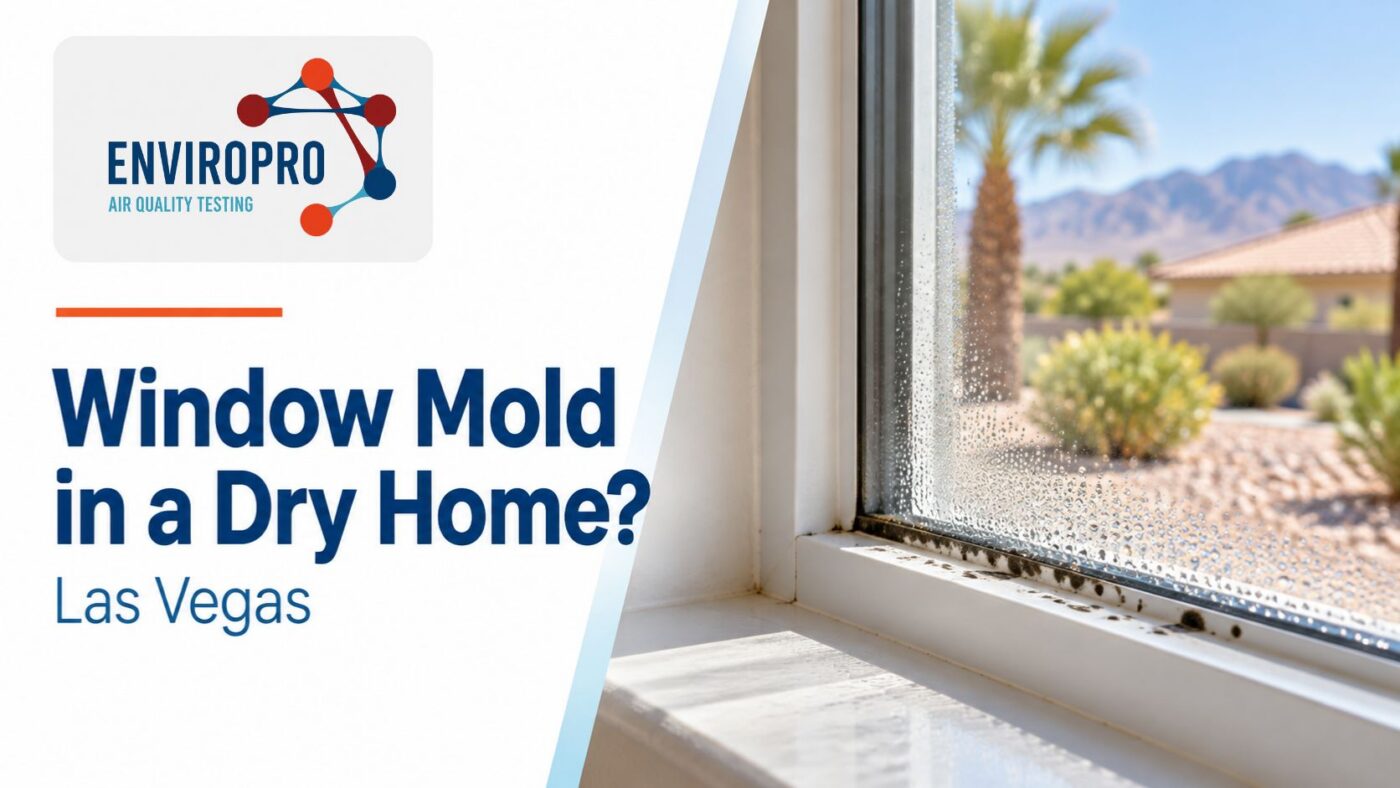
Yes, mold around windows can develop in a Las Vegas home even when the outdoor climate feels extremely dry. Mold does not need humid outdoor weather. It needs moisture at the surface where it is growing, and that moisture may come from condensation on windows, a plumbing or exterior leak, trapped indoor humidity, or water getting into the wall around the frame.
That distinction matters because cleaning the visible spot may be enough for a minor surface issue, but it will not solve an active window leak or moisture trapped behind drywall.
How can mold grow around a window when Las Vegas is so dry?
A dry climate does not mean every part of a home stays dry.
Cooking, showers, people, indoor plants, humidifiers, plumbing, HVAC equipment, and other everyday sources add water vapor indoors. When warmer indoor air reaches a cooler window surface, some of that moisture can condense into liquid water.
The U.S. EPA notes that condensation on windows can indicate excess indoor moisture and that controlling moisture is the primary way to prevent indoor mold growth.
That means a Las Vegas bedroom can feel comfortable while the bottom corner of a window repeatedly becomes damp enough for window mold to develop.
In short: Desert weather lowers outdoor humidity, but it does not prevent localized indoor moisture.
Is condensation or a leak causing the mold?
One of the most useful things you can do is pay attention to when the moisture appears.
What you notice | More consistent with condensation | More consistent with a leak |
Water on the room-side glass | Yes | Sometimes |
Moisture mainly after cold nights | Yes | Less likely |
Dampness after rain | Less likely | Yes |
Mold mainly along the lower sill | Common | Possible |
Peeling paint beside the frame | Possible | More concerning |
Soft drywall or trim | Unusual | More concerning |
Staining spreading beyond window | Unusual | More concerning |
Musty smell inside wall area | Possible | Worth investigating |
Condensation on windows often produces a predictable pattern: moisture appears on the glass first and collects at the bottom of the frame.
A building-envelope leak may behave differently. Water may appear after rain, staining may extend away from the glass, or drywall and trim may remain damp even when the window itself is dry.
Competitor content also consistently identifies repeated condensation, low airflow, and water intrusion as the main explanations for window-area mold.
In short: The location of the mold matters, but the timing of the moisture often tells you more.
Why does mold keep returning after I clean the window?
If the same mold on window sills comes back repeatedly, something is probably allowing the area to become damp again.
Common possibilities include:
- Moisture collecting on cool glass and running onto the sill
- Blinds or curtains restricting airflow
- Damaged exterior sealant or flashing
- Moisture entering around the window assembly
- Damp drywall or wood surrounding the frame
- Indoor humidity remaining elevated near the window
- A previously wet material that never fully dried
The EPA advises homeowners to correct the water source rather than treating mold as a surface-only problem.
Cleaning can remove visible material from an accessible hard surface. It cannot repair failed flashing or dry a wet wall cavity.
In short: Repeated regrowth is a reason to investigate moisture, not simply switch cleaning products.
What signs suggest hidden moisture around the window?
Not every dark speck means there is hidden mold inside the wall.
But some clues make further investigation more reasonable.
Pay closer attention when you notice peeling or bubbling paint, swollen trim, soft drywall, staining below or beside the window, persistent musty odor, dampness after rain, or growth that continues returning despite correcting obvious condensation.
A professional moisture detection inspection can also compare the suspicious area with nearby dry materials. Thermal imaging may help identify temperature patterns that deserve closer investigation, although a thermal camera does not identify mold by itself.
Enviropro uses moisture measurements and thermal imaging as part of its non-invasive inspection process when investigating suspected hidden moisture.
Expert takeaway: A thermal image is a clue, not a laboratory mold result. It helps an inspector decide where additional moisture measurements or sampling may make sense.
Does window mold always need professional mold testing?
No.
If you have a very small amount of visible growth on an easily cleaned, non-porous surface and the moisture source is obvious and corrected, extensive mold testing may add little value.
The EPA states that sampling is generally unnecessary when visible mold is already obvious. It also notes that sampling is more useful when performed by professionals who understand sampling methods and result interpretation.
Professional testing may be more useful when:
- You smell something musty but cannot locate the source.
- The visible area keeps returning.
- Water may have entered the wall.
- Moisture readings suggest materials are still damp.
- You need documented results for a property or remediation decision.
- You want to compare indoor airborne spores with an outdoor reference sample.
This is where a mold inspection and targeted sampling serve different purposes. Inspection looks for the conditions causing the problem. Sampling provides laboratory data when that data will actually answer a useful question.
In short: Test when the result will help you make a decision, not simply because a mold spot exists.
What can a professional window-area inspection check?
For recurring mold around windows Las Vegas homeowners are concerned about, the inspection should focus on the moisture pathway first.
Depending on the conditions, that may include:
- Visual examination around the frame and adjacent wall
- Indoor humidity readings
- Material moisture measurements
- Thermal imaging
- Inspection of nearby baseboards and drywall
- Targeted surface sampling if identification is useful
- Air sampling when hidden growth or indoor spore levels are a legitimate concern
- Comparison with an outdoor control sample where appropriate
At Enviropro Mold & Mycotoxin Testing, the goal is to gather useful data before making assumptions. The company provides Las Vegas mold testing using non-invasive inspection methods, professional air and surface collection, moisture readings, thermal imaging, and laboratory reporting when appropriate.
What should you do when you first notice mold around a window?
Start with the water.
Check whether the window is wet in the morning, after showering, after cooking, or only after rain. Look at the sill, caulk, trim, adjacent drywall, and bottom corners.
If condensation is clearly the issue, improving airflow and controlling indoor moisture may solve the underlying condition. The EPA recommends reducing excess humidity, increasing ventilation, and drying wet surfaces promptly.
If water appears to be entering from outside, the window or building-envelope problem needs repair.
If the source is unclear, repeatedly cleaning the same spot is unlikely to answer the real question.
When should you schedule a mold inspection in Las Vegas?
Consider a mold inspection Las Vegas appointment when the problem behaves like more than a small surface issue.
That includes mold that keeps returning, a persistent odor, moisture around surrounding drywall, recent water intrusion, unexplained staining, or concern that the visible area is only part of the problem.
Enviropro Mold & Mycotoxin Testing serves homeowners in Las Vegas with moisture-focused inspections and lab-based testing when the situation calls for it. The objective is not to turn every stain into a major mold problem. It is to determine what the available evidence actually shows.
Frequently Asked Questions
Usually because the area is repeatedly getting wet from condensation, an exterior leak, poor airflow, or another moisture source.
Yes. Repeated condensation can keep window frames, caulk, drywall, or wood damp enough to support growth if the materials do not dry properly.
Mold responds to moisture immediately around the material, not the regional climate. Indoor condensation, plumbing leaks, HVAC moisture, and water intrusion can all create damp areas in Las Vegas homes.
Moisture that appears after rain, staining outside the normal condensation area, soft drywall, peeling paint, or wet trim can justify checking for exterior water intrusion.
Testing is most useful when the source or extent is unclear, hidden growth is suspected, documentation is needed, or laboratory information would change what you do next.
Yes. Water can sometimes reach drywall, framing, insulation, or other concealed materials. A musty odor or persistent moisture around an otherwise clean-looking frame is a reason to investigate further.
The important question is not whether Las Vegas is dry
The important question is whether the material around your window is staying dry.
Recurring mold around windows is a moisture clue. Sometimes that clue leads to ordinary condensation that can be corrected with better moisture control. Other times, it points to a leak or damp material that deserves a closer look.
If the mold keeps returning or you cannot identify where the moisture is coming from, contact Enviropro Mold & Mycotoxin Testing to schedule a moisture-focused inspection in Las Vegas.
