
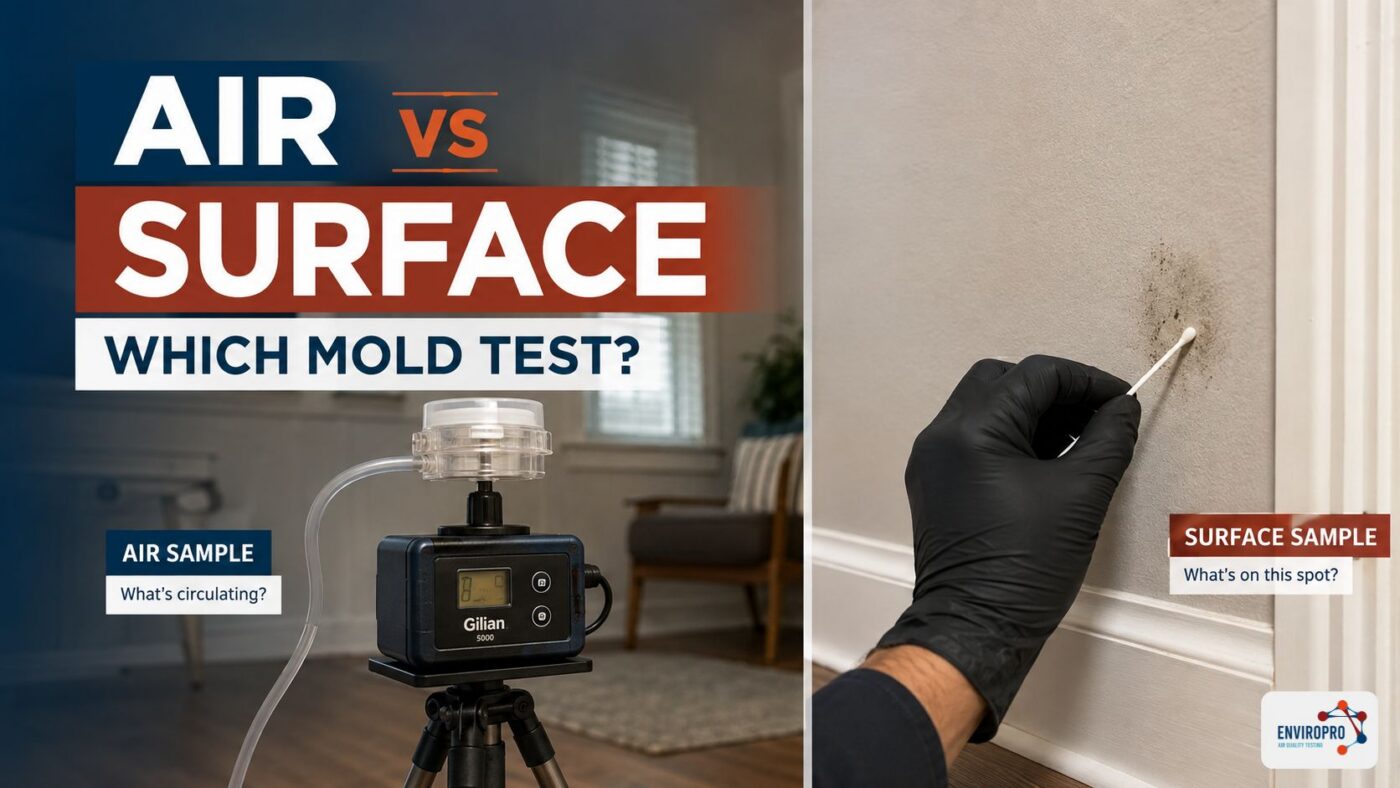
When comparing air mold testing vs surface mold testing, the right choice depends on the question you need answered. Air testing measures mold spores circulating in a room, while surface testing examines material collected from one specific spot. If you smell mold but cannot see it, air testing may provide useful clues. If you have a suspicious stain or visible growth, a surface sample may help identify what is present.
There is also a third possibility: you may not need either test. When mold is clearly visible, and the moisture source is already known, federal guidance says routine sampling is usually unnecessary. Fixing the water problem and addressing the affected material may be the more useful next step.
What is air mold testing?
Mold air testing collects particles from a measured amount of air. A calibrated pump draws air through a sampling cassette, where airborne particles are captured and later examined by a laboratory.
The report may list the mold-spore groups found and their estimated concentration, commonly reported as spores per cubic meter of air. The results describe conditions during the sampling period, not every condition that existed before or after the test.
Professional sampling plans commonly include an outdoor control sample. The indoor results can then be reviewed alongside outdoor conditions because mold spores naturally exist outside and regularly enter buildings.
What can an air sample tell you?
Air sampling may help answer questions such as:
- Are unusual types or concentrations of airborne mold spores present indoors?
- Does one room have a different spore pattern than another?
- Is the indoor result notably different from the outdoor control?
- Could an unseen source be releasing spores into the occupied space?
- Have airborne conditions changed after mold remediation?
Air testing does not automatically locate the source. An elevated result may tell an inspector that further investigation is warranted, but moisture readings, thermal imaging, building history, and visual findings are often needed to narrow down where the problem is coming from.
What is surface mold testing?
Surface mold testing collects material directly from a suspicious or previously contaminated surface. The most common collection methods include tape lifts and sterile swabs.
A tape-lift mold test uses a clear adhesive material pressed against the suspect area. A swab mold test collects material by rubbing a sterile swab over a selected section. In some cases, a small piece of building material may be collected as a bulk sample.
The laboratory examines the sample to determine whether fungal structures are present and what mold groups can be identified. Unlike an air sample, the result applies only to the spot that was sampled.
What can a surface sample tell you?
Surface sampling may help when:
- A stain could be mold, dirt, soot, or another material.
- Growth is visible on drywall, wood, flooring, furniture, or HVAC components.
- An inspector needs information about mold present on a particular material.
- A cleaned surface is being checked during post-remediation verification testing.
- Documentation is needed for a property transaction, insurance matter, or dispute.
Surface testing is targeted. That is its main strength and its main limitation.
Air mold testing vs surface mold testing: side-by-side comparison
Question | Air mold testing | Surface mold testing |
What is collected? | Particles suspended in a measured volume of air | Material taken from a specific surface |
Main purpose | Evaluate airborne mold-spore conditions | Examine suspected growth or contamination at one spot |
Visible mold required? | No | Usually requires a visible or specifically selected area |
Common collection method | Pump and spore-trap cassette | Tape lift, swab, or bulk material |
Area represented | A room or sampling zone during the test | Only the sampled location |
Outdoor control useful? | Yes, usually important for context | Usually not required |
Can it locate the source by itself? | No | Only if the sampled location is the source |
Useful for hidden mold concerns? | May provide clues | Only if the hidden material can be accessed |
Useful after remediation? | Yes, when the protocol calls for airborne comparison | Yes, for checking selected cleaned surfaces |
Best interpreted with | Inspection, moisture data, outdoor sample and building history | Inspection findings, photographs, and material condition |
Neither method is universally more accurate. Accuracy depends on whether the test was selected, collected, and interpreted for the correct purpose.
A test can be technically performed correctly and still be unhelpful if it answers the wrong question.
Which mold test do you need?
Use the situation below that most closely matches your property.
You smell a musty odor but cannot see mold.
Start with a professional mold inspection that includes moisture detection and a review of likely water sources. Air samples may be useful when the inspector suspects hidden growth behind walls, beneath flooring, above ceilings, or around HVAC components.
Air testing alone should not be expected to identify the exact wall or material causing the odor.
Likely approach: Inspection, moisture mapping, and targeted air samples.
You see a suspicious patch or stain.
If the material is clearly mold and the water source is known, testing may not change what needs to happen. Federal guidance states that visible mold usually does not need to be sampled before it is addressed.
A surface sample may still make sense when the material is uncertain, documentation is needed, or the result will affect the remediation plan.
Likely approach: Inspection first; surface testing only when it will influence the next decision.
You had a plumbing leak or water-damage event.
Testing should not replace moisture investigation. The first questions are whether materials are still wet, how far the moisture traveled, and whether porous materials were affected.
Depending on the age and extent of the damage, an inspector may recommend air samples, targeted surface samples, or no samples at all.
Likely approach: Moisture readings and thermal imaging, followed by selective sampling where justified.
You are concerned about indoor air quality.
Air sampling may help document the types and estimated concentrations of spores found in selected rooms. Results are more useful when indoor samples are collected alongside an outdoor control and interpreted with inspection findings.
A mold air test is not a medical diagnosis. People experiencing persistent symptoms should discuss them with a qualified healthcare professional rather than trying to diagnose the cause from a mold report.
Likely approach: Indoor air quality testing, outdoor control sampling, and a building inspection.
You need to check mold remediation work
A post-remediation assessment may include:
- A visual inspection of the work area.
- Confirmation that materials are dry.
- A check for remaining odor, debris, or visible growth.
- Indoor and outdoor air samples when required by the verification plan.
- Surface samples from selected cleaned materials when useful.
The EPA notes that pre- and post-remediation sampling can help evaluate the effectiveness of the work. It also states that indoor air after remediation should have mold types and concentrations similar to the local outdoor air.
Likely approach: Visual and moisture clearance, with air or surface samples selected according to the remediation scope.
When do you need both air and surface testing?
You may need both methods when the investigation involves separate questions about the air and the materials.
For example, imagine that an inspector finds discoloration beneath a kitchen sink after a slow plumbing leak. A surface sample can examine the growth on the cabinet material, while air samples can help assess whether unusual spore conditions are present in the kitchen or nearby rooms.
Both methods may also be used when:
- Visible growth is present, and hidden spread is suspected.
- Several rooms may have been affected by one water event.
- Mold remediation has already taken place.
- Cross-contamination outside the work area is a concern.
- A property owner needs documented laboratory findings.
- Air results need to be compared with a suspected source.
Research comparing residential sampling methods has also found that combined air- and surface-based protocols can provide a more useful assessment than relying on one method alone.
In short: Use both tests when each sample answers a different, necessary question. Collecting extra samples without a reason does not automatically produce a better investigation.
Why a mold inspection should guide the sampling plan
Ordering mold samples before inspecting the property is backwards.
A proper inspection helps determine:
- Where water may have entered.
- Which materials were affected.
- Whether materials remain damp.
- Where staining, odors, or deterioration are present.
- Which rooms should be compared.
- Whether sampling will change the recommended action.
Tools such as moisture meters, hygrometers, thermal imaging cameras, and endoscopic cameras may help identify areas that deserve closer attention. These tools do not confirm mold by themselves, but they help the inspector decide where targeted sampling may produce useful data.
Enviropro Mold & Mycotoxin Testing uses visual inspections, moisture readings, thermal imaging, and professional sampling when evaluating Las Vegas homes and commercial properties. Its process starts with the inspection so samples can be placed according to the property’s actual conditions.
In short: The inspection creates the question. The sampling method is chosen to answer it.
How should mold test results be interpreted?
A mold report should not be reduced to one total spore number.
Interpretation may consider:
- Which mold groups were detected.
- The concentration of each group.
- Differences between indoor rooms.
- Differences between indoor and outdoor samples.
- Whether moisture or visible growth was found.
- Whether certain spores appear indoors but not in the control sample.
- What was happening in the property during collection.
- Whether the sample came from air or a specific surface.
There is no EPA-established federal threshold that divides indoor airborne mold results into universally “safe” and “unsafe” categories. A report therefore requires context rather than a simple pass-or-fail label.
A finding of mold spores also does not automatically prove that a building has an active hidden colony. Mold spores exist naturally in indoor and outdoor environments. The goal is to determine whether the indoor pattern makes sense when compared with the outdoor environment and the physical findings inside the property.
In short: Test numbers matter, but the moisture source, inspection findings, and sample locations determine what those numbers actually mean.
Are DIY mold tests reliable?
A DIY plate or swab may grow or collect mold because mold spores are common in ordinary environments. That result may confirm that spores landed on the test, but it may not tell you where they came from, whether indoor conditions are unusual, or what should be done next.
Common DIY limitations include:
- No inspection-led sampling strategy.
- No calibrated air volume.
- No outdoor control sample.
- Poorly chosen sample locations.
- Contamination during collection.
- Limited explanation of laboratory findings.
- Results that encourage panic or false reassurance.
Professional testing is not useful merely because a professional collects more samples. It is useful when the inspector has a clear reason for each sample and explains how the findings connect to the property.
What does professional mold testing in Las Vegas involve?
A professional mold inspection in Las Vegas should begin with the property, not the laboratory.
At Enviropro Mold & Mycotoxin Testing, the investigation may include visual inspection, indoor moisture and humidity readings, thermal imaging, hard-to-reach-area inspection, outdoor control sampling, indoor air samples and targeted surface samples.
Collected samples are submitted for laboratory analysis, and the report may include detected spore types, indoor and outdoor comparisons, spore concentrations, moisture findings and areas requiring attention. The company states that air and surface results may be available in as little as 24 hours and that same-day appointments may be available when scheduling permits.
The specific method should still be based on your property. A responsible inspector should be willing to explain why each recommended sample is needed and what decision the result will help you make.
Frequently Asked Questions
Neither is automatically better. Air testing evaluates airborne spores in a room, while surface testing examines material from one selected location. The better method is the one that answers the question raised by the inspection.
An air test may provide evidence that warrants further investigation, especially when unusual spores or concentrations are found indoors. It cannot prove the exact location of a hidden source by itself.
Usually not. If mold is clearly visible and the moisture source is known, sampling may not change the required response. Testing may still be useful for documentation, uncertain material, hidden spread, or post-remediation verification.
A properly collected surface sample can provide useful information about the exact spot sampled. It should not be treated as evidence that every other surface in the room has the same conditions.
Yes, an outdoor sample often provides important context because outdoor mold spores naturally enter buildings. Professionals examine the indoor and outdoor patterns alongside moisture and inspection findings rather than comparing only the total counts.
Mold testing can document environmental findings, but it cannot provide a universal medical or safety verdict. No federal airborne-mold threshold exists, and individual health responses vary. Discuss health concerns with a healthcare professional.
Not in every project. The verification protocol should reflect the location, materials, original contamination, and scope of work. Some projects need visual and moisture clearance only, while others benefit from air samples, surface samples, or both.
Get the mold test that answers the right question.
The choice between air mold testing vs surface mold testing is not about picking the more advanced-sounding option. Air samples assess airborne conditions. Surface samples examine a particular material. In some cases, both are useful. In others, a careful inspection and moisture assessment provide enough information without laboratory sampling.
Enviropro Mold & Mycotoxin Testing helps homeowners, renters, property managers, and business owners throughout Las Vegas understand what is happening inside their properties. The team uses non-invasive inspection methods, moisture-detection equipment, and targeted laboratory testing to provide clear findings without fear-based sales tactics.
