
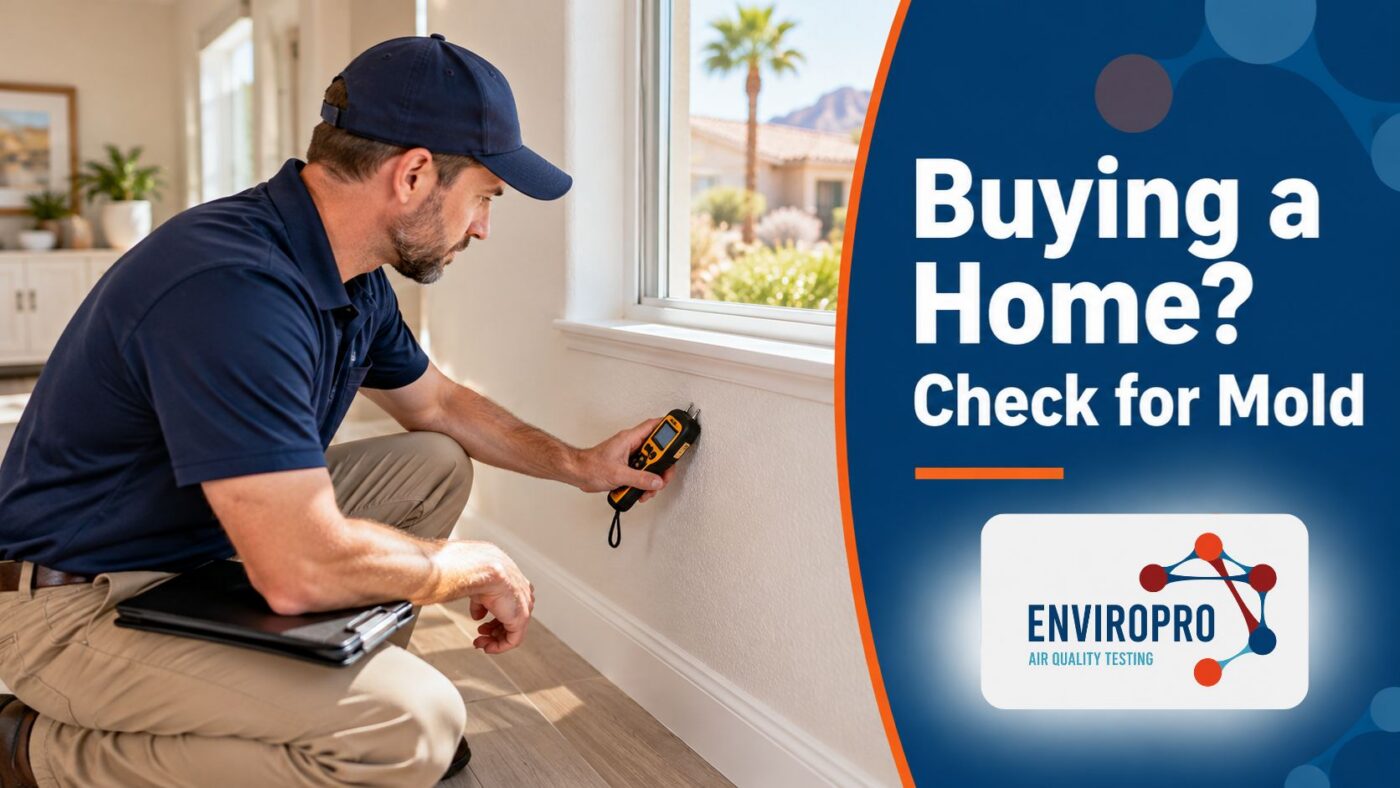
You should consider a mold inspection before buying a home in Las Vegas if the property has signs of or a history of moisture problems, such as musty odors, water stains, plumbing or roof leaks, previous flooding, damaged flooring, suspicious repairs, or unexplained dampness. A separate mold inspection is not automatically necessary for every house.
The goal is not to prove that mold spores exist. Mold spores are common in indoor and outdoor environments. The useful question is whether the property has an abnormal moisture or mold condition that could affect your buying decision.
Is a mold inspection necessary for every Las Vegas home purchase?
No.
A clean, well-maintained property with no musty odor, no visible moisture damage, no relevant repair history, and no concerns raised during the general inspection may not need extensive real estate mold testing.
Several current buyer-focused reference articles make the same distinction: specialized testing makes more sense when moisture red flags appear rather than as an automatic add-on to every transaction.
That is especially useful advice in Las Vegas, where buyers sometimes assume either of two extremes:
“Mold cannot be a problem because this is the desert.”
Or:
“Every property needs extensive laboratory testing.”
Neither assumption is a good substitute for inspecting the actual building.
In short: Let the property conditions determine how deeply you investigate.
What is the difference between a home inspection and a mold inspection?
A general home inspection and a pre-purchase mold inspection overlap in some areas, but they answer different questions.
General home inspection | Specialized mold inspection |
Reviews many major property systems | Focuses on mold and moisture conditions |
May identify staining or leaks | Investigates moisture patterns in greater detail |
May note mold-like material | Can determine whether targeted sampling is warranted |
Broad property assessment | Focused environmental assessment |
Usually not designed around laboratory mold sampling | May include professional air sampling or surface mold testing |
May recommend specialist follow-up | Produces mold/moisture-specific findings |
A general inspector may give you the first clue. A mold specialist can take a closer look when that clue needs to be resolved.
In short: A home inspector identifies broad property concerns. A mold inspector focuses specifically on the moisture and mold question.
What warning signs should buyers take seriously?
You do not need visible black spotting to justify a closer look.
Consider a Las Vegas mold inspection if you notice:
- A persistent musty or earthy odor
- Water stains on ceilings or walls
- Swollen baseboards or flooring
- Peeling or bubbling paint
- Staining beneath sinks
- Evidence of a past plumbing leak
- Recent water-heater or appliance leakage
- Dampness near windows or exterior walls
- Ceiling staining below bathrooms
- Recently replaced drywall in a moisture-prone area
- A disclosed history of water intrusion
- Moisture findings noted by your general inspector
Fresh paint alone is not evidence of mold. Neither is an old repaired leak automatically an active problem.
The question is whether the area was properly dried and whether the moisture source was actually corrected.
Can Las Vegas homes really have hidden mold?
Yes.
Las Vegas has a dry regional climate, but indoor mold growth depends on local moisture within the building.
A pipe can leak behind drywall. An appliance can discharge water beneath flooring. Condensation can develop around HVAC components. Water can enter through part of the building envelope. A bathroom can remain repeatedly damp.
Enviropro’s existing Las Vegas guidance similarly notes that mold problems may occur behind drywall, below flooring, around HVAC systems, or in areas affected by earlier water damage.
That is why hidden mold investigation should follow moisture evidence rather than stereotypes about the desert.
What does a pre-purchase mold inspection include?
The exact scope should depend on the property.
A useful mold testing for home buyers process may include:
- Reviewing the areas that caused concern during the home inspection.
- Visually inspecting accessible moisture-prone areas.
- Checking indoor humidity.
- Taking material moisture measurements.
- Using thermal imaging to identify patterns that deserve closer investigation.
- Checking beneath sinks, near water-using appliances, bathrooms, windows, and other relevant locations.
- Collecting targeted air or surface samples when they would answer a useful question.
- Sending samples for laboratory analysis.
- Providing a written mold testing report that explains findings in plain language.
Enviropro offers moisture and humidity readings, thermal imaging, non-invasive inspection, professional air and surface sampling, indoor/outdoor spore comparison, and lab reporting for Las Vegas properties.
Does every pre-purchase inspection need air sampling?
No.
This is one area where balanced advice is important.
The EPA notes that if visible mold growth is already present, sampling is usually unnecessary simply to establish that mold exists. The CDC also notes that there are no health-based indoor air standards for mold and does not recommend routine air sampling as a universal building-air-quality tool.
That does not mean air sampling has no use.
It means the inspector should have a reason for collecting it.
For example, sampling may provide useful additional information when there is a musty odor but no visible source, when comparing rooms, when investigating an environmental concern, or when documentation is needed.
Expert takeaway: More samples do not automatically mean a better inspection. A good sampling plan starts with a question.
What if the house had previous water damage?
Do not assume either outcome.
A property that leaked can be perfectly reasonable to buy if the water source was repaired, wet material was properly handled, and there is no remaining evidence of moisture or problematic growth.
On the other hand, “the leak was fixed” does not necessarily tell you whether everything that became wet was dried.
EPA guidance recommends drying water-damaged materials promptly, ideally within 24–48 hours, because prolonged dampness increases the chance of mold growth.
If a seller reports prior water damage, useful follow-up questions include:
- Where did the water originate?
- How large was the affected area?
- What materials became wet?
- Were any materials removed?
- Was professional drying performed?
- Are repair or restoration records available?
- Has the area been checked for remaining moisture?
A water damage history is a reason to ask better questions, not automatically a reason to walk away.
What happens if mold is found before closing?
Finding mold does not decide for you.
First, determine the source and extent of the problem. A small localized issue associated with a straightforward repair is very different from unresolved water intrusion affecting multiple areas.
Depending on your contract and professional advice, you may decide to request additional evaluation, ask for correction, negotiate based on documented findings, obtain repair estimates, or reconsider the purchase.
For contract rights, disclosure requirements, or negotiation obligations, rely on your real estate agent or an appropriate Nevada legal professional rather than a mold inspector.
In short: Use the mold report as evidence for a property decision, not as a substitute for real estate or legal advice.
What should Las Vegas buyers ask before ordering testing?
Before scheduling broad sampling, ask:
“What question am I trying to answer?”
If the concern is a damp wall, start by investigating the wall.
If the concern is a musty odor with no visible source, moisture detection, thermal imaging, and carefully selected sampling may make sense.
If visible mold is already obvious and the moisture source is known, additional testing may not be the priority.
This approach can prevent unnecessary upselling and produce information that is actually useful during a real estate transaction.
Frequently Asked Questions
Consider one when the house shows moisture or mold warning signs, has a relevant water-damage history, or your general home inspector identifies something that needs specialized follow-up.
A general inspector may identify visible mold-like growth or moisture concerns, but a dedicated mold inspection is a more focused environmental evaluation.
Musty odors, unexplained staining, swollen flooring, soft drywall, peeling paint, damp cabinets, recurring moisture, and a history of unresolved water damage are common reasons to investigate.
No. Testing is most useful when there is a defined concern, and the result will help you make a decision.
Determine the moisture source and extent first, then discuss your contractual options with your agent or other appropriate professional.
It can include visual evaluation, humidity and moisture readings, thermal imaging, targeted air or surface sampling, lab analysis, and a written report depending on the situation.
Know what you are buying before the keys change hands
A mold inspection before buying a home is not about making a house sound dangerous.
It is about reducing uncertainty when the property gives you a legitimate reason to investigate.
For Las Vegas buyers dealing with musty odors, past leaks, unexplained moisture, or questions raised during a general inspection, Enviropro Mold & Mycotoxin Testing can provide a non-invasive inspection and targeted laboratory testing when appropriate.
