
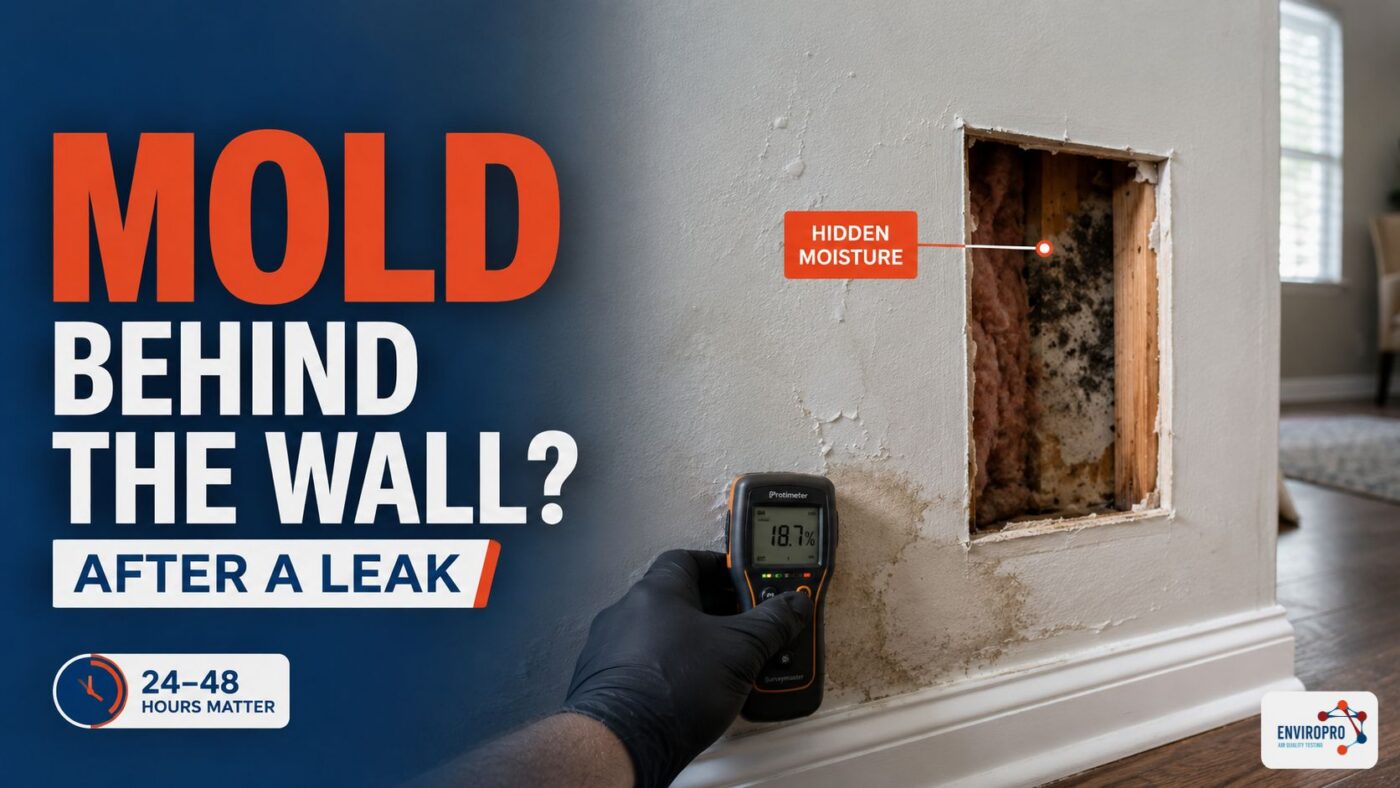
Yes, mold behind walls after a leak can develop when drywall, insulation, wood framing, or other materials remain damp. Fixing the pipe or roof stops additional water from entering, but it does not automatically dry moisture already trapped inside the wall.
The U.S. Environmental Protection Agency recommends drying wet materials within 24–48 hours after a leak or spill. When materials are dried thoroughly within that period, mold growth can often be prevented.
Why can mold grow behind walls after a leak?
A wall cavity can hold moisture long after the visible surface appears dry. Drywall has a paper facing, wood framing absorbs water, and insulation can hold moisture where normal room airflow cannot reach it.
Mold spores are normally present in indoor and outdoor environments. They become a building problem when they land on damp materials and have enough moisture to grow.
Common leak sources include:
- Plumbing lines inside walls
- Roof leaks entering ceilings or exterior walls
- Shower or bathtub leaks
- Window and exterior wall intrusion
- HVAC condensation or blocked drain lines
- Appliance supply-line leaks
- Slow leaks beneath sinks or cabinets
The hidden location matters. A damp wall cavity usually receives less airflow than an exposed floor or countertop, so the inside may remain wet even after the room-facing surface feels normal.
In short: Stopping the leak solves the water source. Drying the affected materials solves the condition that allows mold to grow.
How quickly can mold grow after a leak?
The often-quoted 24–48-hour period should be treated as an action window, not an exact countdown.
EPA guidance states that wet materials should be dried within 24–48 hours to prevent mold growth in most cases. How quickly growth actually becomes established depends on the material, temperature, airflow, amount of water, and how long moisture remains trapped.
Time after the leak | What may be happening | Recommended response |
First few hours | Water may be soaking into drywall, insulation, flooring, or framing | Stop the source, remove standing water, photograph damage, and begin drying |
Within 24 hours | Surfaces may look better while deeper materials remain wet | Check moisture beyond the visible stain and improve controlled airflow |
24–48 hours | Damp porous materials may begin supporting mold growth | Confirm whether materials are actually drying, not merely dry on the surface |
After 48 hours | The likelihood of hidden growth increases when moisture remains | Consider a water damage mold inspection and professional drying assessment |
Several days or longer | Odors, stains, deterioration, or wider contamination may appear | Avoid disturbing suspicious materials until the extent of the problem is understood |
A large flood is not required. A slow drip behind a wall can keep a small area continuously damp for weeks without producing an obvious puddle.
In short: The longer drywall, insulation, or framing stays wet, the more seriously you should treat the possibility of mold after a water leak.
What are the signs of mold behind drywall?
You cannot confirm mold from one stain or odor alone, but several clues together can justify further investigation.
Persistent musty odor
A musty or earthy smell near a wall, cabinet, ceiling, or baseboard may indicate damp material or concealed microbial growth. EPA guidance notes that hidden mold may be suspected when a building smells moldy, but the source cannot be seen.
Water stains that return or spread
A stain that grows, darkens, or returns after repainting suggests the moisture source may still be active. The leak may not have been fully repaired, or the surrounding materials may not have dried.
Peeling paint or bubbling texture
Paint, wallpaper, and wall texture can separate when water moves through drywall. This does not automatically prove mold, but it does indicate that the material has been affected by moisture.
Soft, swollen, or crumbling drywall
Drywall that feels soft, bowed, spongy, or swollen may have absorbed significant water. Water-damaged gypsum and paper facing can deteriorate even when mold is not visible.
Warped baseboards or flooring
Baseboards may pull away from the wall, and nearby laminate or wood flooring may cup or buckle when moisture extends beyond the original leak location.
Unexplained indoor air concerns
Some occupants first investigate after noticing persistent irritation or allergy-like concerns that appear worse in a particular room. Symptoms alone cannot diagnose a mold problem, so the property conditions still need to be evaluated objectively.
What you notice | What it could indicate | Sensible next step |
Musty odor with no visible source | Damp material or hidden mold behind walls | Inspect the leak area and measure moisture |
Peeling paint or bubbling drywall | Water movement through the wall | Verify that the leak is stopped and assess material damage |
Dry-looking wall with a recent major leak | Possible trapped internal moisture | Use a moisture meter or professional inspection |
Visible growth on an exposed surface | An existing mold and moisture problem | Correct the moisture source and determine the affected area |
Odor returning after cleanup | Incomplete drying, remaining material, or another leak | Reinspect the wall cavity and adjacent areas |
In short: Odor, staining, material changes, and a known leak history are stronger warning signs when they occur together.
What should you do immediately after finding a leak?
1. Stop the water source
Shut off the affected supply line when it is safe to do so. Arrange roof, plumbing, window, or HVAC repairs before focusing on cosmetic damage.
2. Remove standing water
Use appropriate extraction methods for clean water. Sewage, floodwater, or other contaminated water requires different safety precautions and should not be handled like a minor clean-water leak.
3. Begin drying promptly
Move furniture away from the area and reduce indoor humidity. Fans and dehumidifiers may help in appropriate situations, but blowing air into contaminated or visibly moldy material can spread particles.
4. Check more than the visible stain
The visible mark may represent only part of the wet area. Water can travel along framing, pipes, flooring, and ceiling materials before appearing inside the room.
5. Document the damage
Take photographs and record when the leak was discovered, when it was repaired, and what drying work was completed. This information may help inspectors, contractors, property managers, or insurance representatives understand the sequence of events.
6. Avoid painting over the damage
Primer and paint can hide a stain without resolving wet drywall, damaged materials, or mold growth. Cosmetic work should wait until the moisture problem has been corrected.
In short: Do not judge the situation by appearance alone. Confirm that both the leak and the retained moisture have been addressed.
Can hidden mold be detected without opening the wall?
A professional mold inspection after a leak often begins with non-invasive methods. Opening drywall is not automatically the first step.
An inspector may use:
- A visual assessment of the leak area
- Moisture meter inspection of drywall, wood, or nearby materials
- Indoor humidity readings
- Thermal imaging for water damage
- Inspection of adjoining rooms, ceilings, floors, or cabinets
- A small endoscopic camera when an appropriate access point is available
- Air and surface mold testing when sampling would answer a specific question
EPA guidance states that moisture meters can help measure water content in wallboard, wood, carpet, brick, and concrete. They can also help monitor whether water-damaged materials are drying.
Thermal imaging may help identify temperature patterns consistent with possible moisture, but it does not identify mold by itself. Findings should be checked with moisture measurements and an inspection of the surrounding conditions.
No tool can see perfectly through every wall. Cabinets, tile, foil-backed insulation, metal framing, recent temperature changes, and air-conditioning patterns can affect readings. When evidence strongly suggests damaged material, limited removal may still be required to determine the full extent.
Enviropro Mold & Mycotoxin Testing uses moisture meters, humidity measurements, thermal imaging, endoscopic inspection tools, professional sampling, and laboratory analysis when appropriate for the property.
In short: Non-invasive tools can narrow down the likely problem area, but they are investigative tools, not magic mold scanners.
When should you test for mold after water damage?
Professional mold testing can be useful when the answer will affect a decision.
Testing may make sense when:
- A musty odor remains, but no source is visible
- A leak occurred inside a closed wall or ceiling
- Occupants need objective information about indoor conditions
- The affected area cannot be inspected directly
- A landlord, buyer, seller, insurer, or property manager needs documentation
- Multiple rooms may be affected
- Remediation has been completed, and independent verification is needed
- The suspected contamination is different from the visible water-damaged area
Testing is not automatically necessary in every situation. EPA guidance states that when visible mold growth is already present, sampling is usually unnecessary. The immediate priorities are correcting the moisture source and addressing the affected material. The EPA also notes that no federal pass-or-fail limits have been established for indoor mold or mold spores.
This means a test should answer a defined question, such as:
- Are indoor airborne spore levels different from the outdoor comparison?
- Is the suspected wall area contributing to abnormal indoor conditions?
- What type of fungal material was collected from a suspicious surface?
- Did cleanup reduce conditions closer to normal background levels?
A dish-style home test may show that mold spores exist, but spores are common in ordinary environments. Without proper sampling locations, controls, laboratory interpretation, and a moisture investigation, the result may create more confusion than clarity.
In short: Test when the findings will guide a real decision. Do not order samples simply because “more testing” sounds safer.
Does drywall always need to be removed after a leak?
No. depends on the water source, saturation level, drying time, material condition, and whether contamination is present.
Drywall may be salvageable when:
- The water source was clean
- The leak was caught quickly
- Moisture exposure was limited
- The material remained structurally sound
- Professional measurements confirm that it dried thoroughly
- There is no visible growth or persistent odor
Removal may be more appropriate when:
- The drywall is soft, swollen, crumbling, or delaminated
- Insulation inside the cavity remains wet
- The leak involved sewage or contaminated water
- Visible growth is present on porous material
- Moisture remained for several days
- Odor continues after drying
- The wall must be opened to repair the leak
- The full affected area cannot otherwise be assessed
Painting, spraying, or wiping the outer surface does not restore deteriorated drywall or remove contamination inside the wall cavity.
In short: Drywall should not be removed automatically, but badly damaged or contaminated porous material should not be kept merely to avoid opening the wall.
What happens if hidden mold is found?
The response should be based on the source of moisture, affected materials, size of the area, and whether contamination extends into adjoining spaces.
A sensible sequence is:
- Confirm that the leak or moisture source is fully corrected.
- Determine the boundaries of the affected area.
- Plan containment before disturbing contaminated materials.
- Remove material that cannot be adequately cleaned or dried.
- Clean salvageable surfaces using appropriate methods.
- Dry the structure and verify moisture levels.
- Complete repairs only after the area is ready.
- Consider post-remediation verification testing when independent confirmation would be valuable.
Testing and remediation are not the same service. A testing company identifies conditions and provides data. A remediation contractor removes contaminated material and performs cleanup.
Keeping those roles separate can give a property owner a more independent way to assess whether cleanup goals were met. EPA guidance says that successful cleanup requires the moisture problem to be fixed and visible mold, mold-damaged materials, and moldy odors to be absent. When sampling is performed, indoor results should be interpreted in relation to the outdoor environment and the goals of the investigation.
Can hidden mold develop in a dry Las Vegas climate?
Yes. Low outdoor humidity does not guarantee that the inside of a wall is dry.
A plumbing leak, roof intrusion, shower leak, or HVAC condensation problem can create a localized damp area that is separated from normal room airflow. Drywall, insulation, cabinetry, and framing may retain moisture regardless of how dry the outdoor weather feels.
Las Vegas property owners should be especially cautious when:
- A leak occurred while the property was vacant
- Water entered an insulated exterior wall
- A ceiling stain appeared below an HVAC unit
- A shower or bathroom wall remains discolored
- A supply-line leak was discovered inside cabinetry
- A roof leak was repaired without checking the ceiling cavity
- An odor appears only when the air-conditioning system runs
Enviropro provides mold testing Las Vegas, Henderson, Summerlin, North Las Vegas, Paradise, and surrounding Clark County communities. Its inspection services include moisture detection, thermal imaging, humidity readings, air sampling, surface sampling, and certified laboratory analysis based on the needs of the property.
Frequently Asked Questions
Yes. It can when moisture absorbed by drywall, insulation, flooring, or framing remains after the water source has been repaired. The repair stops new water but does not automatically dry existing damage.
Wet materials should be dried within 24–48 hours to reduce the chance of mold growth. This is a prevention guideline rather than a guaranteed timeline for every building or material.
Common signs of mold behind drywall include a musty odor, recurring stains, bubbling paint, soft drywall, warped baseboards, and elevated moisture readings. No single sign proves mold, so the leak history and physical condition of the materials must be considered together.
Dry conditions can stop active growth, but drying does not necessarily remove spores, damaged material, staining, or previously established contamination. The moisture source must remain corrected, and affected materials may still require cleaning or removal.
No. A moisture meter identifies elevated moisture in building materials. Since mold commonly grows in damp areas, the reading can help locate places that deserve further investigation, but it does not identify fungal growth by itself.
Not always. When visible mold is clearly present, EPA guidance says sampling is generally unnecessary. Testing is more useful when the source is hidden, the extent is uncertain, documentation is needed, or the property requires post-remediation verification testing.
Cutting into a wall can disturb contaminated material, damage plumbing or wiring, and expose a larger area than expected. When there is strong evidence of hidden moisture or mold, have the area assessed before opening it without a containment plan.
Get clear answers after a leak.
Mold behind walls after a leak is possible whenever building materials remain damp, even when the plumbing or roof repair is already finished. The smartest next step is not to panic or assume every stain is toxic mold. It is to verify that the wall cavity dried, investigate persistent warning signs, and collect useful data when the answer is not visible from the surface.
Enviropro Mold & Mycotoxin Testing provides evidence-based mold inspection Las Vegas services for homeowners, renters, property managers, and businesses. Inspections may include moisture readings, thermal imaging, endoscopic evaluation, professional air or surface sampling, and laboratory analysis based on the property’s conditions.
