
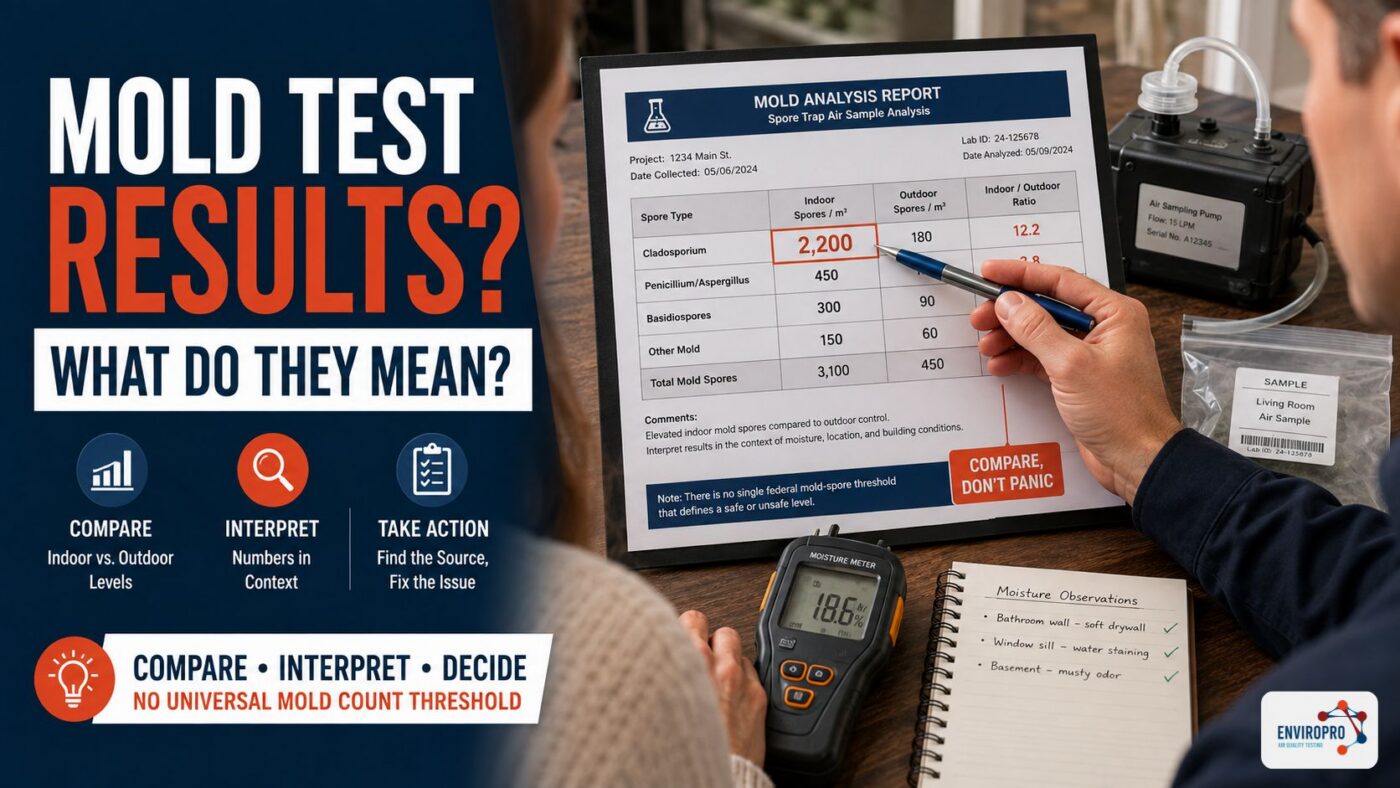
They show which mold spores or materials were detected in the samples, how much was found, and whether the indoor pattern suggests a possible mold source. The numbers should not be judged alone. A useful interpretation also considers the outdoor control sample, the rooms tested, visible damage, moisture readings, odors, and the type of sample collected.
A result marked “elevated” does not automatically mean that your home is unsafe or that major remediation is required. It means the findings deserve closer review so you can determine where the mold may be coming from and whether moisture conditions are allowing it to grow.
What Information Is Included in Mold Test Results?
Most professional mold test results include several categories of information. The exact layout depends on the laboratory and the sampling method, but homeowners commonly see:
- The room or location sampled
- The type of sample collected
- The volume of air tested
- The mold categories or species detected
- Raw spore counts
- Calculated concentrations
- An outdoor control sample
- Laboratory observations or interpretation notes
Air sample results are commonly expressed as spores per cubic meter, written as spores/m³. This number estimates how many spores were present in a cubic meter of air at the time of sampling.
A surface sample works differently. It identifies material collected from one specific area, such as staining on drywall, growth beneath a sink, or residue around an HVAC register. It does not describe the mold level throughout the entire property.
In short: A mold report tells you what was found in the samples. It does not, by itself, explain the full condition of the building.
What Does the Mold Spore Count Mean?
A mold spore count is the estimated concentration of spores detected in an air sample. Homeowners often focus on this number first, but a large number is not automatically dangerous, and a small number is not automatically harmless.
Unlike contaminants that have established residential exposure limits, there is no federal numerical standard that defines an acceptable indoor mold spore count. The EPA states that no federal limits have been established for mold or mold spores.
That means a report should not be interpreted using a universal chart that labels every number as safe, moderate, or dangerous. Interpretation depends on:
- The mold type detected
- The outdoor concentration
- The location of the indoor sample
- Differences between rooms
- Whether the mold is associated with water-damaged materials
- Visible or suspected moisture conditions
- Recent weather, HVAC operation, and property activity
- The sampling method and timing
For example, an indoor sample may contain a relatively high level of an outdoor mold type during a windy day. That may be less concerning when the outdoor sample contains an even higher concentration of the same mold.
A lower indoor count may deserve more attention when the mold category was absent outdoors, appears in only one room, or is associated with damp building materials.
In short: Do not treat the highest number on the report as the entire diagnosis. Look at the pattern.
How Do Indoor and Outdoor Mold Levels Compare?
An outdoor control sample provides a reference point for interpreting indoor vs outdoor mold levels. Because mold is naturally present in the environment, some outdoor spores enter homes through doors, windows, ventilation systems, clothing, and normal foot traffic.
A typical interpretation asks three questions:
- Are indoor counts substantially higher than outdoor counts?
- Are mold types present indoors that were absent or minimal outdoors?
- Does one room have a different mold profile from the rest of the property?
Indoor air does not need to be completely free of mold spores. That is not a realistic expectation. The EPA explains that mold spores occur naturally in both indoor and outdoor air and that eliminating every indoor spore is impossible.
The concern is whether indoor conditions appear to be supporting active or hidden growth.
Example of a less concerning pattern
Finding | Indoor sample | Outdoor sample | Possible interpretation |
Common outdoor mold category | 700 spores/m³ | 1,400 spores/m³ | Indoor air may be reflecting normal outdoor entry |
Species distribution | Similar | Similar | No obvious indoor amplification |
Moisture findings | None detected | Not applicable | No immediate indoor source identified |
Example that may need investigation
Finding | Indoor sample | Outdoor sample | Possible interpretation |
Penicillium/Aspergillus group | 2,200 spores/m³ | 180 spores/m³ | Possible indoor amplification |
Room pattern | High in one bedroom | Not applicable | Localized source may be present |
Moisture findings | Elevated wall moisture | Not applicable | Leak or trapped moisture should be investigated |
These numbers are examples only. They are not universal action thresholds.
In short: The relationship between samples usually matters more than whether one number looks large.
Do the Types of Mold Found Matter?
Yes. Mold species identification can help an inspector understand whether the indoor sample resembles normal outdoor air or suggests growth associated with wet building materials.
Laboratory reports may list categories such as:
- Cladosporium
- Penicillium/Aspergillus group
- Alternaria
- Basidiospores
- Ascospores
- Chaetomium
- Stachybotrys
- Ulocladium
Some categories are commonly found in outdoor air. Others are more often associated with chronically damp cellulose-containing materials, such as drywall paper, ceiling tiles, wood, or insulation.
Finding Stachybotrys or another moisture-associated mold does not tell you how long it has been present or establish a medical diagnosis. It does suggest that the inspector should examine the area for current or previous water damage.
The color of mold is also not a reliable measure of risk. “Black mold” is a broad phrase used by the public, but many molds can appear dark, green, brown, or black. Laboratory identification and building conditions are more useful than color alone.
In short: Mold type can help identify a moisture pattern, but the species name should not be used to create panic.
What Is Considered an Elevated Mold Result?
An elevated mold level usually means that an indoor sample contains a concentration or mold pattern that is noticeably different from the comparison samples.
A result may be considered elevated when:
- An indoor mold category is substantially higher than outdoors
- A mold type appears indoors but not outdoors
- One room has much higher levels than other rooms
- Moisture-associated molds are detected indoors
- Air results support visible inspection or moisture findings
- A post-remediation sample does not meet the project’s clearance criteria
The word “elevated” is not a universal regulatory label. It is an interpretation based on the evidence collected during that inspection.
This is why a report should be reviewed with the person who inspected the property. The laboratory can identify and count the material in the samples, but the inspector connects those findings to the rooms, moisture readings, water history, visible conditions, and reason for testing.
Questions to ask your mold inspector
- Which indoor sample is most concerning, and why?
- How does it compare with the outdoor sample?
- Was the same mold found in other rooms?
- Did you detect elevated moisture near that area?
- Could recent cleaning, construction, or HVAC use have affected the sample?
- Does the result suggest a localized source or a broader issue?
- What additional inspection or testing would change the recommendation?
In short: “Elevated” means the result differs from the expected background pattern. It does not automatically describe the size or severity of the source.
Air, Surface, Dust, and Mycotoxin Results Are Not Interchangeable
Different testing methods examine different parts of the indoor environment. Results may appear inconsistent because the tests were designed to answer different questions.
Test type | What it measures | Best used for | Main limitation |
Mold air testing | Airborne spores collected during a short sampling period | Comparing rooms and indoor air with an outdoor control | Represents conditions only during sampling |
Surface mold testing | Material from one specific surface | Confirming suspected growth or checking a cleaned area | Does not represent the entire building |
Dust testing | Material that settled over time | Examining accumulated environmental history | Influenced by cleaning and dust movement |
Chemical compounds produced by some molds | Investigating specific airborne, dust, or surface contamination questions | Does not independently locate active mold growth | |
Moisture inspection | Dampness, humidity, or temperature differences | Finding conditions that may support mold | Does not identify the mold type by itself |
A clean air sample does not prove that no mold exists behind a wall. Mold may not release spores continuously, and airflow can change from hour to hour.
Likewise, a positive surface sample confirms what was collected from that spot but cannot tell you how much of the surrounding room is affected.
Mycotoxin test results should also be interpreted according to the sample type. Mycotoxins are chemical substances rather than mold spores, and air, dust, and surface testing may produce different findings because they measure different environmental compartments.
Environmental mold or mycotoxin testing does not diagnose a medical condition. Anyone concerned about symptoms should discuss them with a qualified healthcare professional while separately investigating the property.
In short: A test is useful only when it matches the question you are trying to answer.
Does a Positive Mold Test Mean You Need Remediation?
Not necessarily. A positive result simply means mold material was detected. Because mold spores occur naturally, most air samples contain at least some mold.
Whether remediation is appropriate depends on:
- Evidence of active indoor growth
- The location and size of the affected area
- Moisture or water-damage findings
- Whether contaminated material is porous
- The difference between indoor and outdoor results
- Whether the issue is isolated or spread across multiple areas
- Occupant or property-use considerations
- The results of a professional inspection
Testing may also be unnecessary when obvious mold growth is already present, and the source is clear. In many visible-mold situations, the immediate priority is correcting the moisture problem and safely addressing the damaged material. The EPA notes that sampling is often unnecessary when visible growth is present.
Testing becomes more useful when:
- The source is hidden or uncertain
- Several rooms need to be compared
- A musty odor is present without visible growth
- A property has experienced water damage
- Documentation is needed for a rental or real estate matter
- The type of growth needs laboratory identification
- Cleanup has been completed and requires verification
In short: The decision should be based on the building conditions, not the word “positive” alone.
What Should You Do After Receiving Mold Test Results?
Follow a clear sequence instead of jumping directly to demolition or treatment.
1. Review the findings with the inspector
Ask for a plain-language explanation of each sample. You should understand which areas were normal, which were unusual, and what evidence supports the recommendations.
2. Identify the moisture source
Mold growth depends on moisture. The EPA describes moisture control as the key to mold control and recommends fixing the underlying water problem rather than cleaning mold alone.
Possible sources include:
- Plumbing leaks
- Roof or window leaks
- HVAC condensation
- Bathroom ventilation problems
- Appliance leaks
- Previous flooding
- Moisture trapped beneath flooring
- Damp wall or ceiling cavities
Even in Las Vegas, a dry outdoor climate does not prevent mold caused by indoor leaks, condensation, or water damage.
3. Determine the likely extent of the problem
A single affected cabinet is different from several rooms showing elevated results. Moisture mapping, thermal imaging, humidity readings, or targeted inspection may help define the affected area without unnecessary demolition.
4. Develop a scope based on evidence
The next step may involve repairing a leak, removing damaged material, improving ventilation, correcting humidity, or consulting a qualified remediation professional.
Avoid hiring someone who recommends treating the entire home solely because one sample contained mold.
5. Consider post-remediation verification
Post-remediation verification testing may be appropriate after professional cleanup. It can help determine whether the work area is visually clean, dry, and consistent with the project’s clearance criteria before reconstruction begins.
In short: Fix the water source first, determine the actual scope, and verify the work when appropriate.
What If the Results Are Normal but the Home Still Smells Musty?
A normal air sample does not always close the investigation. Air testing captures conditions during a limited window, while hidden mold may be inside a wall cavity, beneath flooring, behind cabinetry, or in an area with little air movement.
Continued investigation may be reasonable when:
- The odor remains in one area
- Moisture readings are elevated
- Staining or material damage is visible
- The property recently had a leak
- The odor changes when the HVAC system operates
- Symptoms or odors improve after leaving the area
- The original sampling locations did not cover the suspected source
The answer is not automatically “collect more samples.” A targeted moisture inspection or examination of a concealed area may provide more useful information than repeating the same air test.
For Las Vegas and Henderson property owners, Enviropro Mold & Mycotoxin Testing uses moisture readings, thermal imaging, professional air and surface sampling, and non-invasive inspection methods to evaluate the test results alongside the property conditions.
In short: Normal air results reduce some concerns, but they do not overrule strong evidence of hidden moisture or localized growth.
Frequently Asked Questions
There is no universal federal number that defines a high residential mold count. A result is interpreted by comparing indoor and outdoor samples, mold categories, room patterns, moisture evidence, and inspection findings.
Indoor levels are generally expected to reflect or remain below the outdoor background for many common outdoor molds. However, weather, ventilation, open doors, HVAC use, and sampling conditions can affect the comparison.
“ND” usually means not detected. It means the laboratory did not detect that category in the specific sample above its reporting limit. It does not prove the substance is absent from every part of the property.
It means Stachybotrys spores or material were identified in the sample. Because this mold is associated with persistently damp cellulose-based materials, the area should be investigated for current or previous moisture damage. The finding alone does not diagnose illness or establish the full size of the problem.
Testing can identify mold patterns and conditions that deserve attention, but it cannot provide a universal “safe home” certificate. Results should be interpreted with inspection findings, moisture conditions, occupant concerns, and the limitations of the sampling method.
Results describe the conditions present when the samples were collected. Leaks, weather, ventilation, cleaning, construction, occupancy, and HVAC operation can change indoor conditions later.
A follow-up test may be useful when you need independent confirmation that the affected area is dry, visibly clean, and no longer showing the same abnormal mold pattern. It is especially useful before walls or flooring are rebuilt over the work area.
Get Clear Answers About Your Mold Test Results
Understanding what mold test results mean requires more than scanning for the largest number. The strongest interpretation looks at the mold types, indoor and outdoor comparison, room-to-room pattern, moisture conditions, inspection findings, and the purpose of each sample.
Enviropro Mold & Mycotoxin Testing provides professional mold testing in Las Vegas for homeowners, renters, property managers, and businesses that need clear, lab-backed answers. The inspection process can include moisture and humidity readings, thermal imaging, air sampling, surface sampling, mycotoxin testing, and detailed reporting based on the property’s conditions.
