
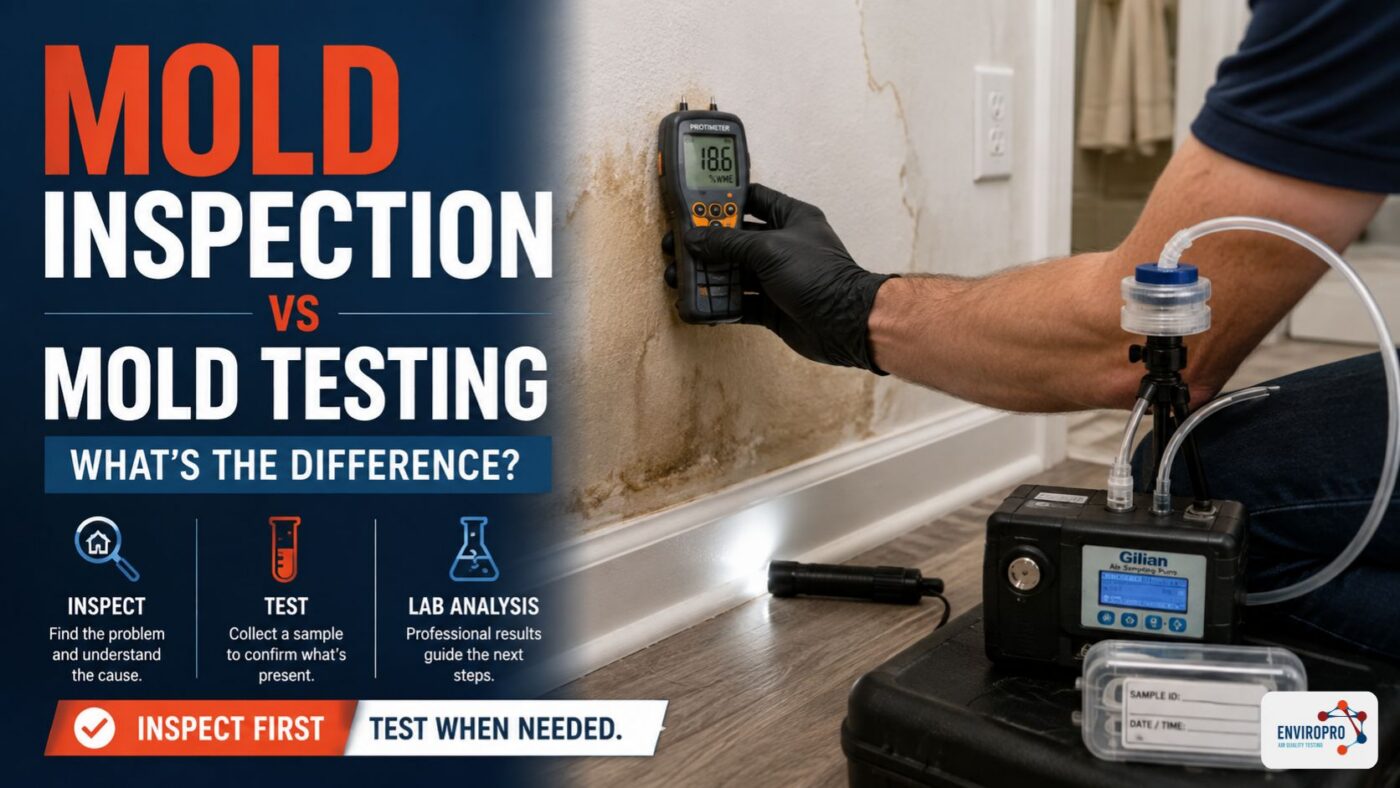
The difference between mold inspection vs mold testing is straightforward: a mold inspection examines the property for visible growth, water damage, excess moisture, and conditions that may support mold, while mold testing collects air, surface, or material samples for laboratory analysis. An inspection helps answer where the problem may be and what caused it; testing helps answer what was found in the selected samples.
You may need an inspection, testing, or a combination of both. The right choice depends on what you can see, whether there has been a leak, where hidden growth is suspected, and what decision the results will help you make.
What Is a Mold Inspection?
A professional mold inspection is a structured investigation of the property. The inspector looks for signs of moisture intrusion, visible microbial growth, staining, musty odors, damaged building materials, condensation, and conditions that may allow mold to develop.
The process usually begins with questions about the property. A recent plumbing leak, roof problem, appliance overflow, previous flood, HVAC issue, or recurring bathroom moisture can help the inspector identify where to focus.
Inspection tools may include:
- Moisture meters
- Humidity meters or hygrometers
- Thermal imaging cameras
- Flashlights and visual inspection tools
- Endoscopic cameras for selected hard-to-see areas
- Air or surface sampling equipment when sampling is justified
Thermal imaging can reveal temperature differences that may point to damp areas, but it does not identify mold by itself. A moisture meter and physical investigation are still needed to evaluate what caused the temperature difference.
Enviropro’s Las Vegas inspection process combines visual assessment with moisture readings, humidity measurements, thermal imaging, and targeted sampling based on the property’s conditions.
In short: An inspection investigates the building. It focuses on moisture, damage, likely growth locations, and the reason the problem developed.
What Is Mold Testing?
Mold testing services involve collecting samples from selected areas and sending them to a laboratory. Testing may identify mold structures or spore types found in the sample and report their concentration or relative abundance.
The three common approaches are air, surface, and bulk sampling.
Mold air testing
During mold air testing, a calibrated pump draws a measured volume of air through a collection cassette. A laboratory examines the captured particles and reports the mold spores or structures observed.
An outdoor control sample may be collected during the same appointment. This provides environmental context because mold spores naturally exist outdoors and can enter a building through doors, windows, ventilation, clothing, and other normal pathways.
The purpose is not to prove that absolutely no mold spores exist indoors. That is unrealistic. The inspector instead looks for indoor patterns that may be unusual relative to outdoor conditions and to the findings from the property inspection.
Surface mold testing
Surface mold testing collects material directly from a suspicious area using tape, a swab, or another suitable method. It may help determine whether discoloration is fungal growth and what was present on that particular surface.
A surface sample only represents the selected location. It does not establish conditions throughout every room or inside every wall.
Bulk material sampling
Bulk sampling involves removing a small piece of affected material for laboratory examination. It is less commonly required and may involve disturbing drywall, insulation, carpet, or another building material.
Sampling should be designed and interpreted by someone with relevant experience. The EPA notes that mold sampling should be performed by professionals familiar with sampling protocols, collection methods, and interpretation.
In short: Testing analyzes selected samples. It does not replace the work of finding the moisture source or inspecting the rest of the property.
Mold Inspection vs Mold Testing: Key Differences
Comparison | Mold Inspection | Mold Testing |
Main purpose | Find visible or suspected growth, moisture, damage, and likely causes | Analyze selected air, surface, or material samples |
Main methods | Visual assessment, property history, moisture readings, humidity measurements, and thermal imaging | Air sampling, tape lifts, swabs, bulk samples and laboratory analysis |
Best suited for | Leaks, musty odors, visible damage, recurring moisture or suspected hidden growth | Situations where laboratory information will affect the next decision |
Identifies moisture source | It may locate or narrow down the source | No, not by itself |
Identifies mold in samples | Not through visual inspection alone | Laboratory analysis may identify structures or categories found in the sample |
Covers the entire property | Depends on the agreed inspection scope | No. Results apply to the samples and conditions at the collection time |
Provides a federal pass/fail result | No | No federal mold concentration limits exist |
Useful after remediation | Visual and moisture assessment can help check the work area | Targeted post-remediation verification testing may provide additional evidence |
In short: An inspection provides building context. Testing provides laboratory data. The strongest investigation uses each only when it answers a relevant question.
Do You Need a Mold Inspection or Mold Testing?
There is no single answer for every property. Start by identifying what you already know and what information is still missing.
You can see apparent mold growth
Begin with an inspection of the affected area and the surrounding moisture conditions. The immediate priorities are determining the extent of the affected materials and correcting the water source.
The EPA states that sampling is generally unnecessary when mold growth is visible. Testing may still be considered when it will change the remediation plan, support documentation, distinguish mold from another substance, or verify a specific concern.
Do not assume the color of the growth identifies the species or level of risk. The CDC advises treating all indoor mold growth as a moisture problem that should be addressed rather than relying on color labels such as “black mold.”
You smell a musty odor but cannot find the source
A hidden mold detection inspection is a sensible first step. The inspector can check plumbing areas, ceilings, flooring, exterior walls, HVAC-adjacent areas, cabinets, and locations affected by previous water damage.
Targeted sampling may be added when the inspection finds suspicious conditions but no accessible visible growth. Random sampling without an inspection may produce numbers without identifying where the moisture problem is located.
The property recently had a leak or water intrusion
Schedule a water damage mold inspection when materials stayed damp, the affected area was not fully accessible, or you are uncertain whether drying was successful.
Water-damaged materials should be dried promptly. EPA guidance generally recommends drying wet areas within 24 to 48 hours to reduce the likelihood of mold growth.
Testing is more useful when the water event is old, hidden areas may have been affected, musty odors remain, or documentation is needed.
Someone is experiencing symptoms
A property inspection can identify dampness, visible growth, and indoor environmental conditions that deserve attention. However, a mold sample cannot diagnose the cause of a person’s symptoms or predict exactly how an individual will react.
Damp buildings and mold exposure are associated with respiratory and allergic symptoms in some people, but symptoms may have many possible causes. Persistent or serious health concerns should be discussed with a qualified healthcare professional.
Environmental testing and medical evaluation answer different questions. Do not use a property test report as a substitute for medical care.
You are buying, selling, renting, or managing a property
A mold inspection Las Vegas property buyers, landlords, tenants, and managers request may help document visible conditions, moisture findings, and areas requiring further investigation.
Testing may be reasonable when the transaction requires written laboratory documentation, the property has a known history of water damage, or the inspection identifies suspicious hidden conditions.
The scope should be agreed upon before sampling. Otherwise, a small number of samples may give the impression that the entire property was tested when it was not.
Remediation work was recently completed
A post-remediation assessment may include visual inspection, moisture evaluation, and targeted post-remediation verification testing.
The purpose is to check whether the agreed work area has been cleaned, affected materials have been addressed, moisture conditions have been corrected, and sample results are reasonably consistent with the project’s clearance criteria.
The EPA notes that surface sampling and pre- or post-remediation sampling may be useful for evaluating whether cleanup efforts were effective. Indoor results are often considered in relation to local outdoor air, but no federal pass/fail concentration exists.
In short: Order testing when the results will support a real decision. Do not order samples merely because testing sounds more scientific.
What Happens During a Professional Mold Inspection and Test?
A properly planned appointment usually follows these steps.
1. Property history review
The inspector asks about leaks, flooding, plumbing repairs, roof problems, musty odors, previous remediation, visible discoloration, occupant concerns, and when the issue was first noticed.
2. Visual assessment
Accessible rooms and agreed areas are checked for water staining, damaged materials, condensation, apparent growth, warped surfaces, peeling paint, and other signs of moisture.
3. Moisture and humidity readings
A moisture inspection helps determine whether building materials are currently damp. Humidity readings provide additional context, particularly in bathrooms, laundry areas, kitchens, HVAC spaces, and rooms with poor airflow.
4. Thermal imaging or limited camera inspection
Thermal imaging may help locate temperature anomalies behind surfaces. When access permits, an endoscopic camera may be used to inspect a limited concealed space without opening a large section of the wall.
These tools provide clues. They do not replace confirmation with moisture readings, direct observation, or appropriate sampling.
5. Sampling plan
If testing is useful, the inspector chooses sample locations based on the inspection findings rather than placing samples randomly.
Enviropro reports using outdoor control sampling followed by selected indoor air or surface samples to evaluate indoor conditions against the outdoor environment.
6. Laboratory analysis
Samples are documented and delivered to the laboratory for analysis. Enviropro states that it works with laboratories accredited through recognized laboratory accreditation programs for mold and mycotoxin testing.
7. Written findings and interpretation
A useful report should explain:
- Where samples were collected
- Why those locations were selected
- Mold structures or categories reported
- Indoor and outdoor comparison data, when applicable
- Moisture and humidity findings
- Areas requiring attention
- Limitations of the inspection
- Practical next steps
In short: The samples are only one part of the process. The building history and moisture findings give the laboratory results meaning.
What Mold Test Results Can and Cannot Tell You
A mold report may identify spore types or groups, show the concentration found in an air sample, or confirm fungal structures on a sampled surface.
It cannot guarantee that every part of the building is free of mold. Air samples capture conditions in selected locations during a limited collection period. Results may vary with ventilation, weather, cleaning, occupant activity, HVAC operation, open windows, and where the samples were placed.
A report also cannot use a federal mold limit to declare a home safe. The EPA confirms that no federal standards or threshold limits have been established for airborne mold concentrations.
This is why interpretation should consider:
- Indoor results compared with outdoor conditions
- Species or spore patterns that differ between locations
- Visible growth and water damage
- Moisture readings
- The building’s history
- The sampling method and locations
- Whether the findings answer the original inspection question
A large number without context can be misleading. A lower result does not automatically rule out hidden growth, and a higher result does not identify the source without further investigation.
In short: A test report is evidence, not a complete diagnosis of the building.
Why Mold Can Still Develop in Las Vegas Properties
Las Vegas has a dry outdoor climate, but mold growth depends on moisture at the material, not the city’s average weather.
Indoor problems can develop around:
- Plumbing leaks
- Water heater failures
- Air-conditioning condensate
- Shower and bathroom moisture
- Roof or window intrusion
- Appliance supply lines
- Damp cabinets
- Wet flooring or drywall
- Previous water damage that was covered before drying
A small, concealed leak can affect drywall, wood, insulation, or flooring without creating an obvious puddle. That is why a water damage mold inspection Las Vegas property owners request should focus on the moisture path, not simply the visible stain.
Fixing the leak is not always the end of the investigation. The surrounding material may remain damp, and moisture may have traveled farther than expected.
How to Choose a Mold Inspection Company
Before scheduling, ask what the service includes. “Mold test” can mean anything from one air sample to a detailed property investigation, so the scope matters.
Ask these questions:
- Will you inspect for moisture before choosing sample locations?
- Which rooms and building areas are included?
- What tools will be used?
- How will you determine the number and type of samples?
- Will an outdoor control sample be collected?
- Which laboratory analyzes the samples?
- Will the report explain the findings in plain language?
- What are the inspection’s limitations?
- Do you provide post-remediation verification testing?
- What information should I provide before the appointment?
The EPA recommends asking potential mold professionals about their qualifications, training, experience, and references. It does not operate a federal certification program for mold inspectors.
Enviropro states that its technicians hold mold-inspection and indoor-air consulting certifications and that the company is licensed and bonded.
Frequently Asked Questions
A mold inspection evaluates the property for moisture, visible growth, water damage, and conditions that could support mold. Testing collects selected samples for laboratory analysis.
Inspection findings help determine whether sampling is needed and where samples should be collected.
Not always. EPA guidance says sampling is generally unnecessary when visible mold growth is already present. The priorities are determining the extent of the affected area, correcting the moisture source, and addressing the damaged materials.
Testing may still be useful when documentation, post-remediation verification, identification of a questionable substance, or another specific decision requires laboratory data.
An inspection may identify evidence of hidden moisture or conditions consistent with concealed growth, but no non-invasive inspection can guarantee that every wall cavity has been examined.
Moisture meters, thermal imaging, building history, odor patterns, and limited camera access may help narrow down suspicious locations.
No. One or two air samples do not inspect every room, wall cavity, or building material.
Air sampling should be part of a planned investigation. The number and location of samples should reflect the property layout, inspection findings, HVAC zones, and reason for testing.
No. There is no federal airborne mold concentration that provides a universal pass/fail definition of a safe home.
A qualified inspector should explain the laboratory findings alongside moisture conditions, visible observations, outdoor samples, and the limitations of the collection process.
A home kit may collect mold because mold spores are naturally present in indoor and outdoor environments. The difficult part is determining what the result means, where the spores originated, and whether a moisture problem exists.
Professional sampling is more useful when it follows an inspection and uses controlled collection methods, documented sample locations, appropriate laboratory analysis, and experienced interpretation.
Not every small cleanup requires sampling, but post-remediation verification testing may be valuable for larger projects, hidden contamination, property transactions, managed buildings, sensitive occupants, or situations requiring documentation.
The post-remediation scope and acceptance criteria should be decided before the final samples are collected.
Get Clear Answers About Mold in Your Las Vegas Property
The key difference in mold inspection vs mold testing is that an inspection investigates the property, while testing analyzes selected samples. In many cases, the inspection should guide the testing rather than the other way around.
Do not pay for random samples that leave you with a laboratory report and no explanation of the moisture source. Start with the questions you need answered, then choose the inspection and sampling scope that can answer them.
Enviropro Mold & Mycotoxin Testing provides non-invasive inspections, moisture and humidity readings, thermal imaging, professional air and surface collection, laboratory analysis, and clear reporting for residential and commercial properties in Las Vegas and surrounding Clark County communities.
