
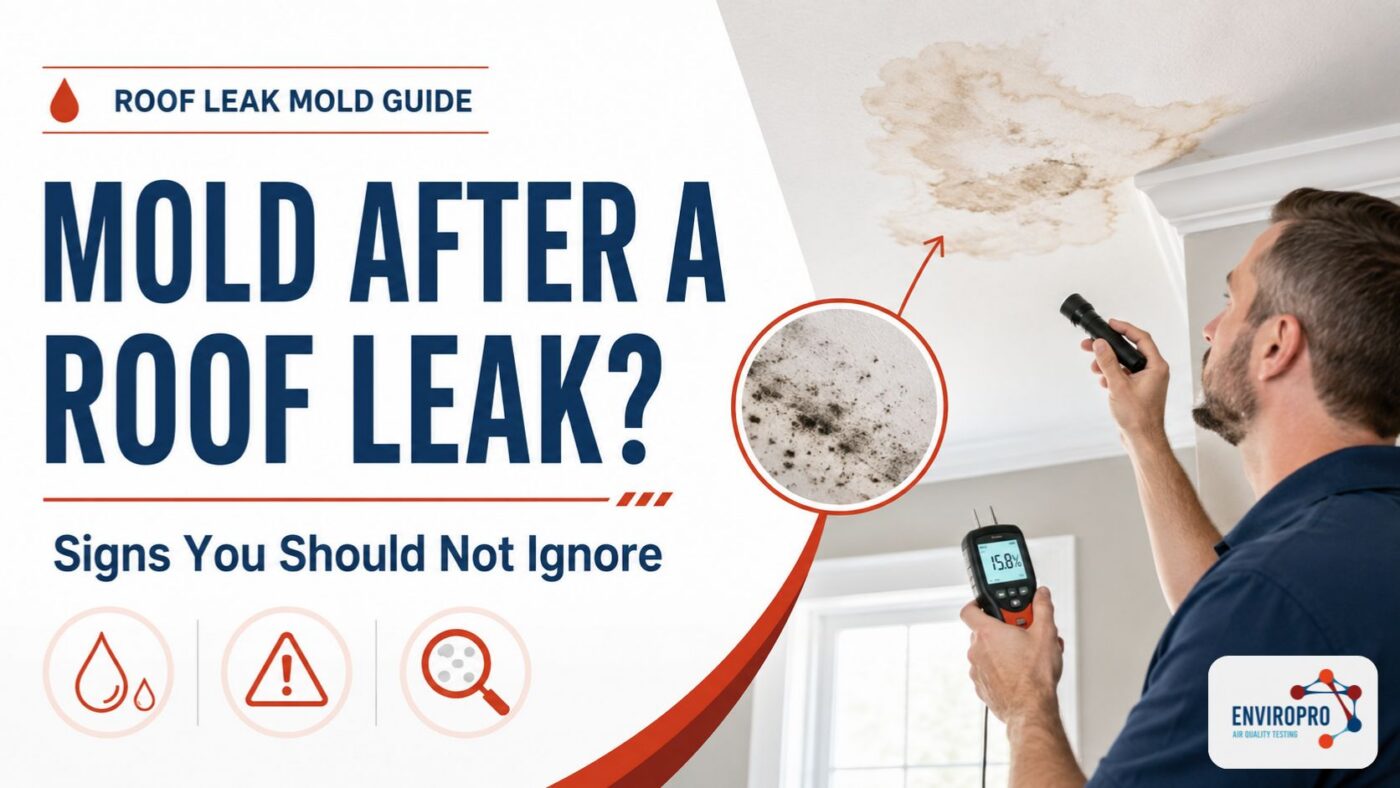
Mold after a roof leak can grow when moisture gets trapped in ceiling drywall, insulation, attic materials, or wall cavities. The signs you should not ignore include ceiling water stains, a musty odor, soft drywall, peeling paint, dark spots near vents or corners, and any stain that returns after rain.
A roof repair stops new water from coming in, but it does not always tell you whether moisture or mold is already inside the property. That is where a professional mold inspection and water damage mold inspection can help.
Can a roof leak cause mold?
Yes. A roof leak can cause mold when water enters through shingles, flashing, vents, skylights, pipe boots, or other roof openings and stays trapped long enough to support growth.
The tricky part is that roof leak mold does not always show up on the ceiling right away. Water may travel along rafters, insulation, electrical openings, or drywall seams before it becomes visible.
A small stain in the living room may have started several feet away in the attic.
In short: A roof leak can cause mold even if the visible damage looks minor. The key question is not only “Did the roof leak?” It is “Where did the moisture go?”
Signs of mold after a roof leak, you should not ignore
Some warning signs are obvious. Others are easy to dismiss as old staining, dust, or normal attic odor.
Here are the signs that deserve a closer look.
1. Ceiling water stains that grow or return
A yellow, brown, rust-colored, or gray stain can mean water has reached the ceiling assembly. If the stain gets larger after rain, the leak may still be active.
Do not paint over the stain until the source is fixed and the material is dry. Paint can hide the problem while moisture remains behind it.
2. A musty odor in one area of the home
A musty odor after a roof leak is one of the strongest clues that moisture may be trapped somewhere you cannot see.
The smell may be stronger:
- After rain
- When the air conditioner turns on
- In closed rooms or closets
- Near attic access
- In top-floor rooms
A smell by itself does not prove mold type or severity, but it does tell you the area needs investigation.
3. Soft, sagging, or bubbling drywall
Drywall is porous. Once it absorbs water, the paper backing and inside layers can stay damp even after the surface looks dry.
Watch for:
- Soft spots when gently pressed
- Sagging ceiling sections
- Bubbling paint
- Cracked texture
- Edges that look swollen or wavy
This is where a moisture inspection matters. Guessing by touch or appearance is not enough.
4. Dark spots near attic access, vents, or corners
Dark spots can appear where moisture collects, where air movement is poor, or where roof leakage is affecting materials above the ceiling.
Color alone cannot identify mold species. Many molds can look black, gray, green, or brown. If you are worried about dark growth, black mold testing or surface mold testing may help document what is present.
5. Stains below skylights, roof vents, or ceiling lights
Roof penetrations are common leak points. Water can enter around flashing, vent boots, skylights, solar penetrations, chimney areas, or older sealant.
If staining appears around a ceiling light or smoke detector, avoid touching the fixture until the area is checked safely.
6. Attic discoloration or damp insulation
Not all roof leak damage shows up inside the room first. Sometimes the earliest clues are in the attic.
Possible attic mold signs include:
- Dark patches on the roof sheathing
- Damp or compressed insulation
- Rust on nails or metal fasteners
- A stale or earthy smell
- Water trails on wood framing
- Condensation around vents or ductwork
In Las Vegas, attic heat can dry some surfaces quickly, but trapped moisture can remain in insulation, corners, or shaded areas.
In short: Visible mold is not the first warning sign. Odor, staining, soft materials, and attic changes can show up earlier.
Roof repair, mold testing, or mold remediation: what do you need?
After a roof leak, people often call the wrong company first or expect one service to solve every part of the problem.
Here is the clean way to think about it.
|
Situation |
Who usually helps |
Why it matters |
|
Active roof leak, missing shingles, damaged flashing |
Roofer |
Stops new water from entering |
|
Stains, odor, damp ceiling, unknown moisture path |
Water damage mold inspection company |
Checks whether moisture or mold may be present |
|
Visible growth, contaminated drywall, and affected insulation |
Mold remediation contractor |
Removes affected materials and cleans the area |
|
After the cleanup is finished |
Post-remediation verification testing provider |
Confirms whether the cleaned area meets the inspection goal |
|
Odor with no visible growth |
Indoor air quality testing or mold air testing provider |
Helps assess possible airborne mold concerns |
Enviropro Mold & Mycotoxin Testing focuses on inspection, sampling, moisture detection, and reporting. That means the goal is not to sell unnecessary removal work. The goal is to help you understand what is happening inside the property.
In short: Fix the roof source first, then test or inspect the affected area if there are signs of moisture, odor, staining, or possible hidden mold.
When should you schedule a water damage mold inspection?
You should schedule a water damage mold inspection when there are signs that water may have reached hidden building materials.
This is especially smart when:
- The leak affected a ceiling, attic, closet, wall, or HVAC area
- The leak happened more than a day ago
- The ceiling has stains, bubbling paint, or soft spots
- You smell mold, but cannot see it
- The home has children, older adults, allergy-sensitive people, or immune-sensitive occupants.
- You rent or manage the property and need documentation
- Repairs were completed, but no one checked moisture levels
- You are buying or selling a property with a past roof leak history
A water damage mold inspection Las Vegas appointment may include visual checks, moisture meter readings, humidity readings, thermal imaging inspection, and sampling if the findings support it.
In short: If the roof leak touches porous materials, testing or inspection can save you from guessing.
How professionals check for hidden mold after a roof leak
A good inspection does not start with fear. It starts with the moisture path.
A trained inspector looks at where the water likely entered, where it traveled, and which materials may have stayed damp.
Visual inspection
The inspector checks stains, attic areas, drywall seams, vents, closets, ceiling corners, roof-adjacent rooms, and previous repair areas.
They also look for patterns. A stain below a skylight tells a different story than mold around an air vent.
Moisture and humidity readings
Moisture meters can help identify damp areas that may not feel wet by hand. Hygrometers help measure indoor humidity.
This step is useful because a ceiling can look dry while moisture remains inside insulation or drywall.
Thermal imaging inspection
A thermal imaging inspection can show temperature differences that may point to hidden moisture. It does not “see mold,” but it can help locate areas that deserve closer testing.
This is especially useful after roof leaks because water can travel away from the entry point.
Mold air testing and surface mold testing
Mold air testing can help compare indoor mold spore levels against an outdoor control sample. This is useful when there is an odor, a health concern, or possible airborne contamination.
Surface mold testing may be used when there is visible growth or a stained material that needs lab confirmation.
Lab reporting
Professional testing gives you a report that can explain what was sampled, where samples were taken, what the lab found, and what the next step may be.
That is far better than trying to decide based on color, smell, or internet photos.
In short: Professional testing does not replace roof repair or remediation. It gives you data, so the next decision is based on evidence.
What not to do when you suspect a roof leak or mold
A few common reactions can make the problem harder to solve.
Avoid these mistakes:
- Do not paint over mold or water stains before checking moisture.
- Do not cut into stained drywall without knowing what is behind it.
- Do not run fans directly at visible mold.
- Do not assume the attic is fine because the room below looks dry.
- Do not mix bleach with other cleaners.
- Do not rely on smell alone to decide the size of the problem.
- Do not close up the ceiling before confirming the area is dry.
Small surface mildew on a non-porous bathroom surface is one thing. Mold tied to roof leakage, ceiling stains, or damp insulation is different.
If the issue is limited and easy to clean, a homeowner may be able to handle basic cleaning safely. If the leak affected drywall, insulation, attic wood, or HVAC areas, it is better to inspect first.
In short: Cosmetic fixes can hide moisture. Moisture is what brings the problem back.
Why Las Vegas homes can still get mold after roof leaks
People often assume mold is only a humid-climate problem. Las Vegas is dry, but homes can still develop mold when water gets trapped indoors.
After a roof leak, moisture may stay inside:
- Ceiling drywall
- Attic insulation
- Roof sheathing
- Wall cavities
- Around ductwork
- Behind paint or texture
- In closets with poor airflow
The desert climate may dry exposed surfaces faster, but hidden areas do not always dry evenly. Closed cavities, insulation, and shaded attic sections can hold moisture longer than expected.
That is why Las Vegas mold testing after a roof leak should focus on both moisture detection and sampling when needed.
Enviropro serves Las Vegas, Henderson, Summerlin, North Las Vegas, Paradise, and nearby Clark County communities with mold testing Las Vegas and indoor air quality inspection services.
In short: Dry weather helps, but it does not cancel out trapped water inside building materials.
When black mold testing or mycotoxin testing may make sense
Dark mold after a roof leak can be unsettling, but color alone does not prove what type of mold is present.
Black mold testing may be useful when there is dark visible growth, roof-related water damage, or a need to document lab results before deciding on next steps.
Mycotoxin testing may be considered when there are stronger concerns about mold-related toxins, prior water damage, ongoing odors, or indoor air quality questions that need a more detailed look.
Not every roof leak requires mycotoxin testing. Honest guidance matters here. In many cases, a mold inspection, moisture readings, and targeted air or surface sampling are the right starting point.
In short: Start with the problem you can document: water source, moisture location, visible growth, odor, and lab sampling when needed.
What to do in the first 24 hours after a roof leak
If the leak just happened, take simple steps before the damage spreads.
- Stop the water source if it is safe to do so.
- Call a roofer if the roof is actively leaking.
- Move furniture, rugs, boxes, and valuables away from the wet area.
- Take clear photos of stains, dripping, wet materials, and the date.
- Do not disturb suspected moldy materials.
- Ventilate the area if it is safe, and the weather allows.
- Schedule a moisture inspection if drywall, insulation, or attic areas were affected.
- Ask about mold air testing or surface mold testing if there is odor, visible growth, or concern about indoor air quality.
For renters, report the leak and moisture concern to the landlord or property manager in writing. Include photos and dates so there is a clear record.
In short: The roof leak needs repair, but the indoor materials need attention too.
Frequently Asked Questions
Yes. Mold after a roof leak can develop when water enters the attic, ceiling, insulation, or wall cavities, and the area stays damp. Mold needs moisture to grow, so the roof source should be fixed before cleanup or reconstruction.
Look at the pattern. Roof leak mold often appears below roof lines, skylights, vents, attic spaces, exterior ceiling corners, or areas that stain after rain. A mold inspection can help separate roof leakage from plumbing leaks, HVAC condensation, or indoor humidity.
Testing is worth considering if there are ceiling water stains, a musty odor, visible growth, soft drywall, damp insulation, or concern about hidden mold. If there is obvious visible growth and wet materials, inspection may be more useful than testing alone.
Yes. Attic mold can grow on roof sheathing, framing, insulation, or stored items when roof water enters, and moisture is not corrected. The living area below may not show obvious mold at first.
Dark mold should be taken seriously, but color alone does not identify the species. Black mold testing can help document what is present. People with asthma, allergies, respiratory sensitivity, or immune concerns should avoid disturbing suspected mold and should consider professional guidance.
If water is actively entering, call a roofer first to stop the leak. Then schedule a water damage mold inspection if interior materials were wet, stained, soft, musty, or not checked for moisture.
Only after the area has been checked and confirmed to be dry. Painting too soon can hide moisture damage and may allow mold or staining to return. If the stain came with odor, softness, or visible growth, schedule a moisture inspection first.
Do not guess about mold after a roof leak
Mold after a roof leak is not always visible, and the first sign may be a stain, smell, soft ceiling, or damp attic material. A repaired roof is a good first step, but it does not prove that the ceiling, insulation, or attic space is dry and clear.
If your Las Vegas property has had a roof leak, Enviropro Mold & Mycotoxin Testing can help you get clear answers through mold inspection, moisture detection, mold air testing, surface mold testing, and lab-backed reporting.
