
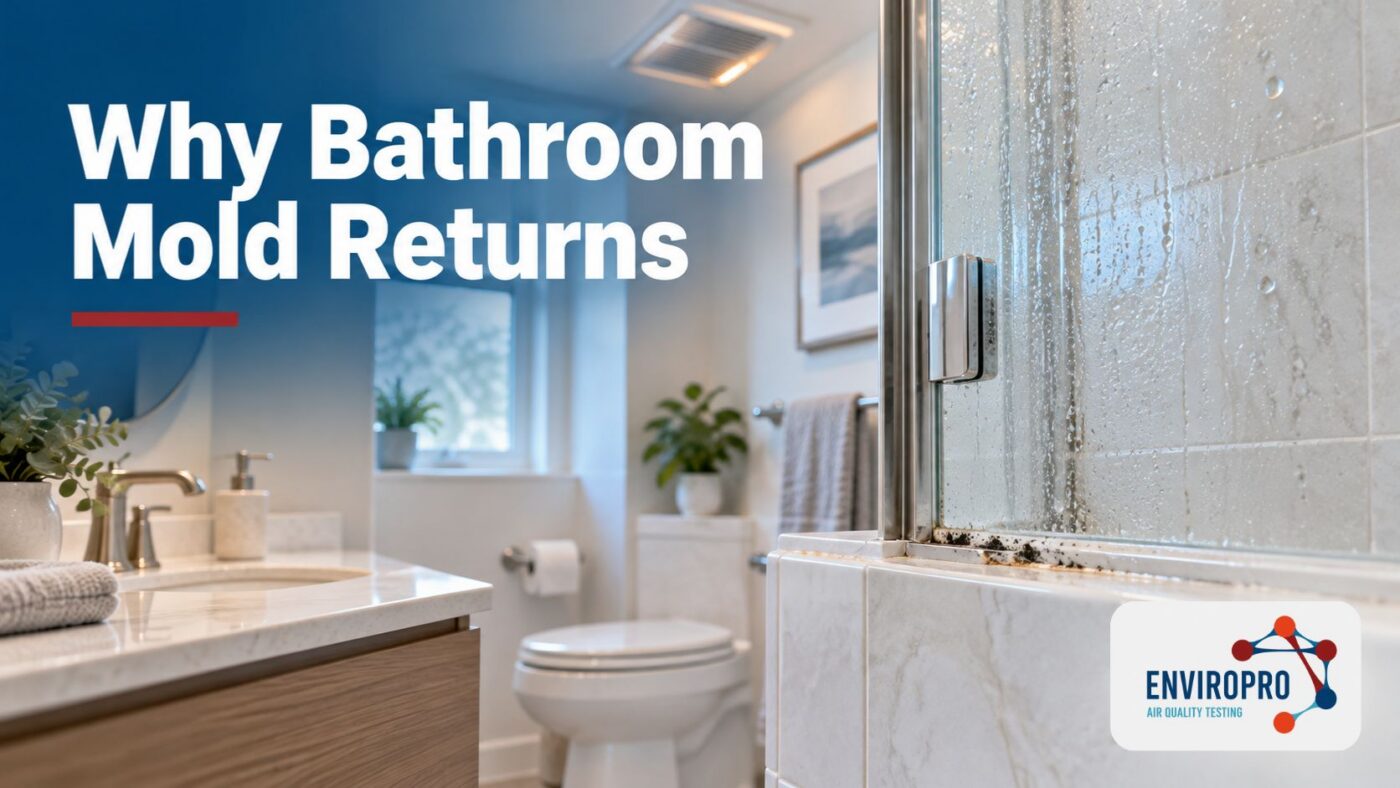
If bathroom mold keeps coming back, the most likely reason is that the moisture allowing it to grow has not been corrected. Cleaning can remove visible material, but recurring shower condensation, poor bathroom ventilation, a slow plumbing leak, damp drywall, failing caulk, or moisture behind tile can recreate the same conditions.
In a Las Vegas home, dry outdoor air does not prevent this. A bathroom creates its own short bursts of humid air every time someone showers.
Why does bathroom mold return after cleaning?
The U.S. EPA gives a simple principle: controlling mold means controlling moisture. If mold is cleaned but the water problem remains, it is likely to return.
That explains most cases of bathroom mold after cleaning.
The visible spot may disappear, but the room still goes through the same wet-dry cycle every morning. Or a small leak continues wetting material behind the surface.
Reference articles focusing specifically on recurring bathroom mold repeatedly identify ventilation problems, condensation, hidden leaks, and moisture behind porous materials as the main reasons growth returns.
In short: If the environment stays the same, the mold problem can repeat even after the surface looks clean.
Is the problem shower humidity or a hidden leak?
Both can produce dark spotting, but the pattern is often different.
Pattern | More consistent with shower humidity | More consistent with hidden water |
Ceiling spotting above shower | Common | Possible |
Mold in several upper corners | Common | Less specific |
Growth mainly on grout or caulk | Common | Possible |
One exact spot repeatedly returns | Possible | More concerning |
Wall feels soft or swollen | Unusual | More concerning |
Stain keeps expanding | Unusual | More concerning |
Damp vanity cabinet | Less likely | Common with plumbing leak |
Musty odor with little visible mold | Possible | Worth investigating |
A bathroom that simply stays wet too long may need better bathroom ventilation and more drying time.
A bathroom where one area remains damp no matter how well the room is ventilated may have another source of moisture.
In short: Widespread condensation patterns and a single persistent damp spot should not automatically be treated as the same problem.
Where does recurring bathroom moisture commonly come from?
A few areas deserve closer attention before assuming the entire bathroom has a mold problem.
Exhaust ventilation
A fan needs to move moisture out of the room rather than simply make noise.
If mirrors remain fogged and walls stay wet long after the shower ends, moisture is not leaving efficiently.
Shower and tub joints
Cracked or separated caulk can allow repeated water entry.
That does not automatically prove mold behind walls, but it creates a reason to look more carefully when nearby drywall or trim is also affected.
Under the sink
Slow supply-line or drain leaks can wet the cabinet or wall for a long time before water becomes obvious.
Around the toilet
Moisture near the toilet base may warrant checking the plumbing connection and adjacent flooring rather than treating the discoloration as a cleaning-only issue.
Ceiling or wall penetrations
Plumbing above a bathroom, roof leaks, HVAC components, or water from an adjoining room can sometimes create a misleading bathroom mold pattern.
Does bleach stop bathroom mold from coming back?
A cleaning product cannot correct a leak or improve ventilation.
For a small amount of growth on an appropriate hard surface, cleaning and complete drying may be reasonable. The EPA recommends detergent and water for hard surfaces, followed by thorough drying, while noting that moldy porous materials can be much harder to clean completely.
Be cautious with online claims that a specific household chemical permanently “kills” every mold problem. The material involved, moisture source, size of the affected area, and whether growth extends below the surface all matter.
In short: Cleaning may address the surface. Moisture control determines whether the problem has a reason to return.
When is recurring bathroom mold more than a cleaning issue?
Repeated recurrence deserves closer attention when:
- Growth returns in the same location
- The area remains damp between showers
- Drywall feels soft or swollen
- Paint bubbles or peels
- A musty odor persists after cleaning
- The vanity or baseboard shows water damage
- Staining appears on the opposite side of the wall
- The source of moisture cannot be identified
- There was a known plumbing or water event
That does not mean every case requires extensive demolition or broad mold testing Las Vegas homeowners sometimes assume they need.
It means you have reached the point where identifying the water source is more valuable than cleaning the stain again.
When does professional mold testing help?
A bathroom mold inspection can help when the key question is not simply “Is that spot mold?”
If something is visibly growing, identifying the moisture problem may be the priority. EPA guidance notes that routine sampling is not necessary in every situation where visible mold is already present.
Testing becomes more useful when you need to answer a specific question, such as:
- Is there evidence of elevated airborne mold when little is visible?
- Is suspicious material actually fungal growth?
- Is an adjacent room affected?
- Are indoor airborne levels unusual compared with an outdoor control?
- Did cleanup meet agreed post-remediation conditions?
Enviropro can combine moisture detection, humidity measurements, thermal imaging, and targeted sampling rather than relying on one test alone.
Expert takeaway: Lab data is most useful when the inspection question is clear before the samples are taken.
How can Las Vegas homeowners reduce recurring bathroom moisture?
Start with drying rather than disinfecting.
Use the exhaust fan during bathing and allow it to continue removing moisture afterward. Wipe persistent water from shower surfaces, pay attention to cracked caulk, and address plumbing leaks promptly.
The EPA recommends using bathroom exhaust ventilation and keeping indoor humidity controlled to reduce conditions that support mold growth.
For bathroom mold Las Vegas homeowners deal with repeatedly, the desert climate can actually make the source easier to overlook. People assume mold should not occur here, so a small leak or poorly ventilated shower may continue for months before anyone investigates it.
What should you do before scheduling an inspection?
Take a few photos before cleaning again.
Note whether the problem appears after showers, after plumbing use, or independently of either. Check whether the same area feels different from nearby dry materials.
That simple information can help an inspector understand the moisture pattern more quickly.
Do not open walls solely to look for mold unless there is a legitimate reason and the work can be done safely. Non-invasive tools may provide useful information before destructive investigation is considered.
Frequently Asked Questions
Usually because moisture continues to return from shower humidity, poor airflow, plumbing, failed seals, or damp material.
Cleaning removes what you can reach. It does not stop condensation, repair plumbing, or dry concealed wet material.
It is not a solution to the underlying moisture source. For small hard surfaces, follow appropriate cleaning guidance, dry the area thoroughly, and correct the reason it became wet.
Yes. It can, particularly when growth repeatedly appears in one location, materials feel damp or damaged, or staining occurs near plumbing.
Consider testing when hidden growth is suspected, airborne conditions are a concern, identification will affect the next decision, or documented results are needed.
Find and correct the source of moisture first. That may mean improving ventilation, repairing a leak, replacing failed sealant, drying wet materials, or having an unclear moisture problem professionally investigated.
Stop cleaning the same spot without asking why it is wet
When bathroom mold keeps coming back, the pattern is information.
It may point to a bathroom that simply needs better moisture control, or it may lead to a plumbing or concealed moisture issue that is not visible from the room.
If you have recurring bathroom mold in a Las Vegas property and cannot identify why the area keeps getting wet, Enviropro Mold & Mycotoxin Testing can inspect the moisture conditions and determine whether targeted testing would provide useful answers.
