
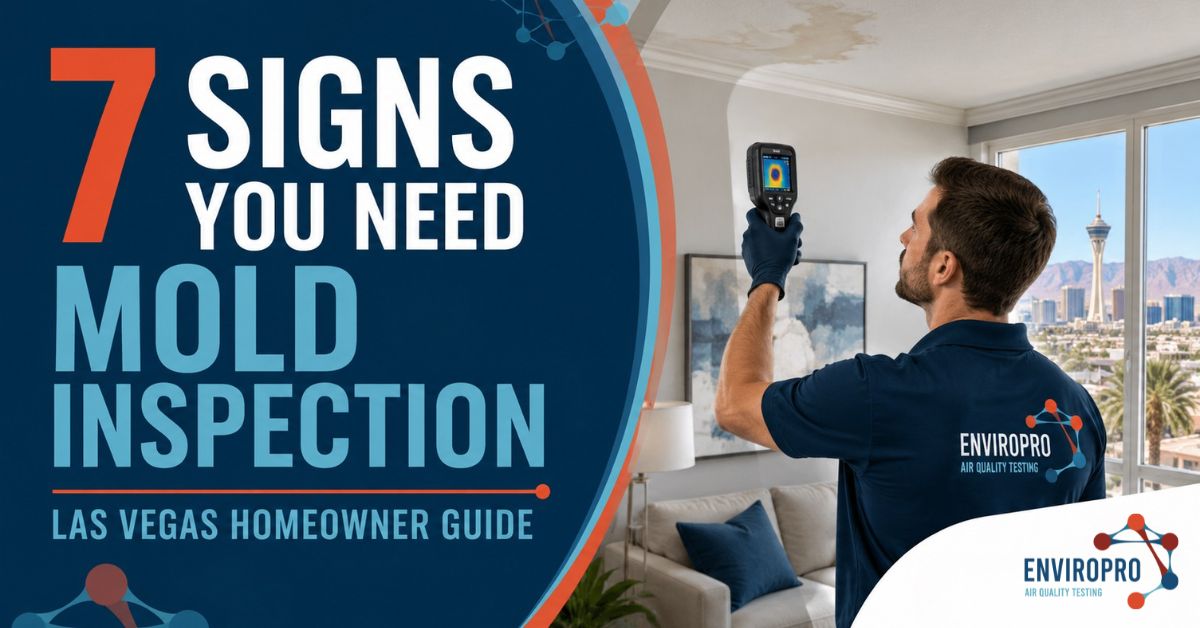
If you’ve landed here, you probably already suspect something. The short answer: you likely need a mold inspection when you can smell mold but can’t see it, when you’ve had water damage in the last year, or when people in the home feel better the moment they leave it. Those three situations are the ones that send most Las Vegas homeowners looking for answers, and they’re usually worth checking.
Below are the seven signs worth paying attention to, plus the honest part most pages skip: when you can probably hold off and just keep an eye on things.
Why Mold Is a Real Problem in a Dry Desert City
It seems backwards. Las Vegas is one of the driest places in the country, so how does mold survive here?
Outdoors, it mostly doesn’t. Indoors is a different story. Air conditioners run for much of the year and create condensation around ducts and coils. Evaporative (“swamp”) coolers add humidity by design. Slab-on-grade foundations can wick moisture upward. And during monsoon season, roughly July through September, a single roof or window leak can soak drywall that nobody dries out properly.
That last pattern is the one inspectors see most: water gets cleaned up, everyone assumes it’s handled, and a musty smell shows up six to eight weeks later. The moisture was never really gone.
In short, Las Vegas mold problems are almost always indoor moisture problems, not climate problems, which is why they hide so well.
The 7 Signs You Need a Mold Inspection
1. A musty or earthy smell you can’t trace
That damp, “old basement” odor is one of the most reliable early warnings of hidden mold. Mold releases gases as it grows, and your nose often catches it before your eyes do.
If the smell lingers in one room, gets stronger near a vent, or returns after you clean, the source is likely behind a wall, under flooring, or inside your HVAC system.
2. Recent water damage, a leak, or flooding
Mold can begin growing within 24 to 48 hours of water exposure. A burst supply line, an overflowing water heater, a slow leak under a sink, or storm water through the roof are all classic triggers.
The danger is the invisible aftermath. Even after the visible water dries, moisture trapped inside drywall and framing keeps feeding growth you can’t see. A water damage mold inspection checks those hidden cavities with moisture meters and thermal imaging.
Tip: If you leaked in the past year and never had it checked, that’s the single most common reason to schedule an inspection.
3. Stains, discoloration, or spots that come back
Look for fuzzy patches, dark dots, or greenish-black streaks on walls, ceilings, baseboards, or around vents. People often mistake these for dirt or soot until they grow or reappear after cleaning.
Returning stains usually means an active moisture source behind the surface. That’s a different (and bigger) issue than a one-time splash.
4. Bubbling, peeling, or warped surfaces
Paint that blisters, wallpaper that lifts at the seams, or drywall that bows outward is a sign of water trapped behind the material. Where there’s persistent trapped moisture, mold frequently follows.
5. Health symptoms that ease when you leave home
This is the sign people underestimate. Mold spores in the air can trigger coughing, sneezing, congestion, itchy eyes, headaches, or unexplained fatigue.
The telling pattern: symptoms fade on vacation or at the office and flare back up at home. Children, older adults, and anyone with asthma or allergies tend to react first. If your home’s air seems to be making someone feel unwell, indoor air quality testing can show whether spore levels indoors are higher than what’s drifting in from outside.
6. Condensation on windows, mirrors, or ductwork
Frequent fogging means indoor humidity is higher than it should be. Over time, that moisture settles on sills, drywall edges, and around AC components, prime spots for growth in our climate.
7. You’re buying, selling, or managing a property
Real estate transactions add a different kind of pressure. Buyers want to know what they’re inheriting, sellers want to avoid surprises, and property managers need documentation when tenants report a problem. A clear, lab-backed mold testing report gives everyone facts instead of guesses.
In short, one sign on its own may be nothing. Two or more together, especially a smell plus past water damage, is a strong reason to get a professional mold inspection.
When You Might Not Need Testing Yet
Not every spot of mold needs a lab. Here’s the honest version.
If you can clearly see a small patch (smaller than roughly a square foot) on a hard, non-porous surface like tile or glass, and you know exactly where the moisture came from and it’s already fixed, you can often clean it yourself and watch the area. Spending money on testing in that case may not tell you anything you don’t already know.
You’ll want a professional inspection instead when:
- The affected area is large or spreading.
- You can smell mold, but can’t find it.
- It’s on porous material (drywall, carpet, wood) where it can root deep.
- Someone in the home is having health symptoms.
- The moisture source is unknown or keeps coming back.
We’d rather tell you to keep an eye on a minor spot than sell you a test you don’t need.
Mold Inspection vs. Mold Testing: What’s the Difference?
People use these terms as if they’re the same. They’re not, and knowing the difference helps you ask for the right thing.
|
Mold Inspection |
Mold Testing |
|
|
What it does |
Visual walkthrough, moisture readings, and thermal imaging to find problem areas and their source |
Collects air and surface samples sent to a lab |
|
The main question it answers |
“Where is the moisture, and is there visible mold?” |
“What type of mold is it, and how much?” |
|
Tools used |
Moisture meters, thermal cameras, and endoscopic cameras |
Air pumps, swabs, tape lifts, and certified lab analysis |
|
Best when |
You suspect a problem or have had water damage |
You need to confirm the type, severity, or clear a remediation |
In practice, a thorough visit usually combines both: find the moisture, then sample to confirm what’s actually in the air and on surfaces.
In short: An inspection locates the problem; testing measures it. Most reliable answers come from doing both together.
What Actually Happens During a Professional Mold Inspection
Knowing the steps takes the mystery (and the fear) out of it.
- Walkthrough and history. The inspector asks about leaks, water events, and where you’ve noticed smells or symptoms.
- Moisture and thermal scan. Moisture meters and thermal imaging reveal damp spots behind walls without tearing anything open, a non-invasive approach.
- Air sampling. Spore counts are taken indoors and compared against an outdoor baseline, so results reflect your home, not just background levels.
- Surface sampling. Swabs or tape lifts are pulled from suspect areas.
- Certified lab analysis. Samples go to an accredited lab to identify mold types and concentrations.
- Plain-language report. You get results explained in normal words, with what they mean and what (if anything) to do next.
This is the kind of work Enviropro Mold & Mycotoxin Testing focuses on for homes and businesses across Las Vegas, with clear data, explained simply, without scare tactics.
A Quick Word on Black Mold and Mycotoxins
“Black mold” usually refers to Stachybotrys, which can produce compounds called mycotoxins. It tends to show up on cellulose materials, such as drywall paper, cardboard, and wood, after prolonged water exposure.
Here’s the calm truth: color alone doesn’t tell you how dangerous mold is. Plenty of harmless molds look dark, and some risky ones don’t. The only way to know what you’re dealing with is black mold testing or broader mycotoxin testing through a lab, not a guess based on a photo.
How Much Does a Mold Inspection Cost in Las Vegas?
Pricing depends on the size of the property and how many samples are needed, since each air or surface sample carries a lab fee. A small condo with one suspect area costs far less than a large home needing multiple rooms tested.
The honest guidance: ask for transparent pricing before scheduling, and make sure the quote spells out how many samples are included. A vague “it depends” with no numbers is a red flag.
Frequently Asked Questions
If it's a small spot on a hard surface and the moisture source is fixed, cleaning may be enough. If it's on porous material, spreading, smelly without a visible source, or tied to symptoms, get it inspected.
Persistent musty odors, returning stains, condensation, or symptoms that improve when you leave home all point to hidden mold. Moisture readings and air sampling confirm it.
Yes indoors. AC condensation, swamp coolers, slab moisture, and monsoon-season leaks create the damp pockets mold needs, even when the outdoor air is bone dry.
Not automatically, and not equally for everyone. Risk depends on the species, the amount, and who's exposed. Lab testing is the only reliable way to identify it.
Visual and moisture findings are available the same day. Lab-analyzed air and surface results typically take a little longer, depending on the lab's turnaround.
After mold is removed, post-remediation verification testing confirms the cleanup worked, and spore levels are back to normal useful proof for landlords, buyers, and peace of mind.
If there are any signs of odor, past water damage, or staining, yes. It's far cheaper to know before closing than to discover a hidden problem after you own it.
If you noticed one or two signs on this list, you’re not overreacting; you’re being smart. A musty smell with no source, recent water damage, or symptoms that fade when you leave home are the clearest reasons to schedule a mold inspection, especially in a city where moisture hides so well indoors.
And if your situation turns out to be minor, a good inspector will tell you that too.
Want a straight answer instead of a guess? Enviropro Mold & Mycotoxin Testing serves Las Vegas, Nevada, with lab-backed air and surface testing, moisture detection, and reports written in plain English, no fear-based sales tactics, no upselling.
