
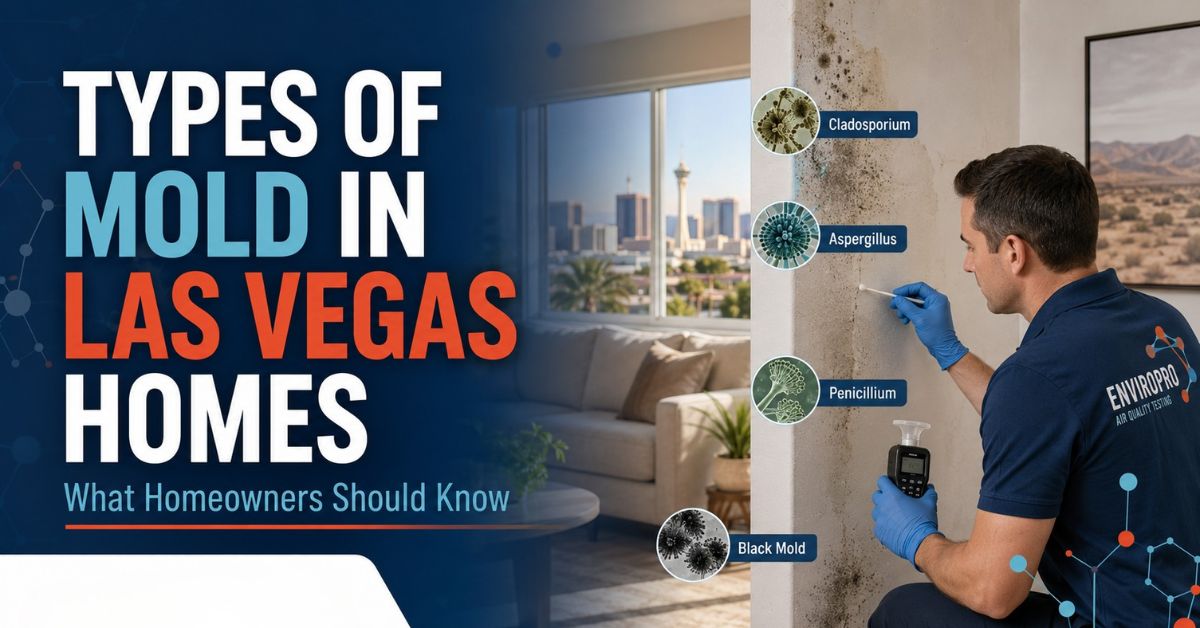
The most common types of mold in Las Vegas homes are Cladosporium, Aspergillus, and Penicillium. True “black mold” (Stachybotrys) shows up far less often than people expect. Despite the desert air outside, indoor moisture from swamp coolers, HVAC systems, plumbing leaks, and monsoon flooding creates the damp conditions mold needs to grow.
If you’ve spotted a dark patch on a wall or caught a musty smell that won’t clear, this guide will help you understand what you might be dealing with and what to do next.
Why Does a Dry Desert Like Las Vegas Get Mold at All?
This is the question almost everyone asks first, and it’s a fair one. Las Vegas has some of the driest outdoor air in the country.
The catch is that mold doesn’t care about outdoor humidity. It cares about the moisture inside your walls and air.
Here, that moisture is usually created by something in the home, not the weather:
- Swamp coolers with old or unmaintained pads that stay wet
- HVAC condensation around coils and ductwork
- Plumbing leaks under sinks, behind showers, or inside walls
- Flat roof failures common in many valley homes
- Monsoon-season flooding that doesn’t fully dry out
- Window condensation on single-pane glass in winter
In short, Las Vegas stays dry outside, but the moisture problems that feed mold are man-made and hidden indoors.
What Are the Most Common Types of Mold in Las Vegas Homes?
Lab reports across the valley keep pointing to the same handful of species. Here’s what each one is, where it tends to grow, and why it matters.
Cladosporium
If one mold shows up on more local lab reports than any other, it’s this one. It appears in shades of olive green, brown, and dark gray, often with a velvety look.
Cladosporium doesn’t need heavy, sustained water. It thrives on moderate, consistent moisture, window sill condensation, bathroom grout that never fully dries, and the backs of cabinets against exterior walls.
It’s mainly an allergen. Exposure can cause watery eyes, a runny nose, coughing, and skin rashes.
Aspergillus
Aspergillus is a large group that covers over 300 species and appears in a wide range of colors, including black, brown, yellow, and green. It grows on drywall, insulation, and dust inside HVAC systems, and it establishes quickly after a water event that wasn’t completely dried.
In Las Vegas, neglected swamp cooler pads are a frequent culprit, creating a path for spores to travel through the duct system.
For most healthy people, it causes allergic and respiratory irritation. In people with weakened immune systems, it can cause invasive aspergillosis, a serious and potentially life-threatening infection.
Penicillium
Penicillium is a common indoor mold, often blue-green, with a musty odor that many people completely dread. It dries fast once materials get damp and is frequently found alongside water damage.
Large concentrations can cause allergic reactions, and immunocompromised individuals may be subject to lung or sinus infections when exposed to high levels.
Stachybotrys chartarum (“Black Mold”)
This is the one everyone worries about. Here’s the truth: most homeowners who think they have black mold don’t.
Stachybotrys is genuinely more demanding than other molds. It needs humidity around 93%, which is why it almost always appears after significant water damage rather than from everyday immunocompromiseds wet, cellulose-rich materials like drywall, ceiling tiles, and wallpaper.
It can produce mycotoxins and is associated with allergic reactions, flu-like symptoms, and worsening asthma, but its reputation often outpaces how frequently it actually turns up locally.
Alternaria
Less common indoors but worth knowing. Alternaria is an allergenic mold that prefers damp spots like showers, sinks, and around windows. It’s a typical sign of a moisture problem that’s been left unaddressed.
In short, the everyday molds in Las Vegas are Cladosporium, Aspergillus, and Penicillium. Stachybotrys exists, but it’s the exception, not the rule.
Can You Identify Mold by Its Color?
No, and this is one of the most important things to understand.
Color tells you almost nothing reliable about species. Aspergillus alone can appear black, brown, green, and white depending on the growth stage and the material it’s colonizing.
“Black mold” has become a catch-all term for any dark growth, which is exactly why so many people misidentify what they have. The only way to identify mold species is laboratory analysis of an air or surface sample.
A guess based on a photo can send you toward the wrong cleanup plan. A lab result removes the guesswork.
Quick Comparison: The Main Las Vegas Molds
|
Mold Type |
Typical Color |
Common Location |
Moisture Needed |
Main Concern |
|
Cladosporium |
Olive-green, brown, gray |
Window sills, grout, cabinet backs |
Moderate, consistent |
Allergen |
|
Aspergillus |
Varies (black–white) |
Drywall, HVAC, dust |
Quickly after water events |
Allergen: serious for the immune-compromised |
|
Penicillium |
Blue-green |
Damp walls, water-damaged materials |
Moderate |
Allergen: possible infection at high levels |
|
Stachybotrys |
Greenish-black |
Wet drywall, ceiling tiles |
Very high (~93% RH) |
Mycotoxins are tied to heavy water damage |
|
Alternaria |
Dark green/brown |
Showers, sinks, windows |
Damp areas |
Allergen |
Where Mold Tends to Hide in Las Vegas Homes
Some of the most established colonies are the ones you can’t see from the room. A few patterns that come up repeatedly:
- Behind shower walls, a slow drain or a shower pan leaks, where the tile still looks clean
- Attic homes that look perfectly normal inside, with only a faint musty smell upstairs
- Below the window frames, winter condensation is draining into the wall cavity
- Around HVAC coils and ducts, condensation feeds spores into the air you breathe
- Inside walls near plumbing leaks that go unnoticed for months
In short: By the time you see or smell mold, the source is often well-established somewhere you can’t see.
When Should You Get Mold Testing?
Testing makes sense when you have a real reason to suspect a problem, not for every faint smell.
Consider professional testing if you notice:
- A persistent musty odor that doesn’t clear after ventilation
- Visible discoloration on walls, ceilings, or grout
- Recent water damage, a roof leak, or a plumbing failure
- Allergy or respiratory symptoms that improve when you leave the house
- You’re buying or selling a home and want clarity
- You’ve had remediation done and want verification that it worked
It’s also fair to mention the other side: the CDC takes the position that no matter what type of mold is present, you need to remove it, and that good sampling can be expensive, with no set standards for acceptable quantities. Testing earns its value when you need to confirm whether mold exists, identify the species, locate a hidden source, or document conditions for a sale or insurance claim.
If you simply have a small, visible patch and already know the moisture cause, cleaning up and fixing the leak may matter more than a lab report.
What a Mold Test Actually Tells You
A test isn’t about confirming mold exists; it’s about answering questions you can’t answer by looking.
A professional inspection and lab analysis can tell you:
- Which species are present (not just “dark stuff on the wall”)
- Spore levels indoors compared to outdoors
- Whether there’s a hidden source behind walls or in the attic
- A written report you’re cleaning up for remediation planning or a real estate transaction
This is the work Enviropro Mold & Mycotoxin Testing focuses on for homeowners and businesses across the Las Vegas valley, including air and surface sampling sent to accredited labs, moisture and humidity readings, thermal imaging to find hidden wet areas, and plain-language reports. The goal is clear answers, not pressure.
In short: A lab report turns a guess into a decision you can act on.
Expert Tips for Las Vegas Homeowners
- Keep indoor humidity between 30% and 50%. Above 60%, condensation starts forming on surfaces and creates the damp conditions mold needs.
- Maintain, including your swamp cooler pads. Old, wet pads are a top hidden mold source here.
- Fix leaks fast. Most local mold traces back to a water source that sat too long.
- Don’t sand or scrub suspected black mold. Disturbing it releases spores; get it identified first.
- Check upstairs rooms near the ceiling for faint musty smells; that can signal an attic issue.
Frequently Asked Questions
Cladosporium appears on more local lab reports than any other type, followed closely by Aspergillus and Penicillium.
No. "Black mold" usually refers to Stachybotrys, but many molds look dark. Only lab testing confirms the species.
It can be. Outdoor dryness doesn't prevent indoor moisture from being produced by swamp coolers, leaks, or HVAC systems, and mold grows wherever that moisture collects.
Yes. Condensation around coils and ducts is a common growth spot, and the system can then circulate spores through the home.
Not always. If you have a small visible patch and know the moisture source, cleanup may matter more. Testing helps most when mold is hidden, the species is unclear, or you need documentation.
Timing depends on the lab, but reputable testing companies typically return accredited lab results within a few days, sometimes faster.
An inspection finds the moisture source and visible signs; testing collects air or surface samples to identify the species and spore levels through a lab.
The types of mold in Las Vegas homes you’re most likely to encounter are Cladosporium, Aspergillus, and Penicillium, with true black mold being far less common than its reputation suggests. The desert climate doesn’t protect your home; indoor moisture does the damage. And since color can’t tell you what you’re dealing with, lab testing is the only way to get real answers.
If you’ve noticed a musty smell, visible growth, or recent water damage and want to know exactly what’s in your home, Enviropro Mold & Mycotoxin Testing provides professional inspection and accredited lab analysis across Las Vegas, with clear results and no fear-based sales tactics.
