
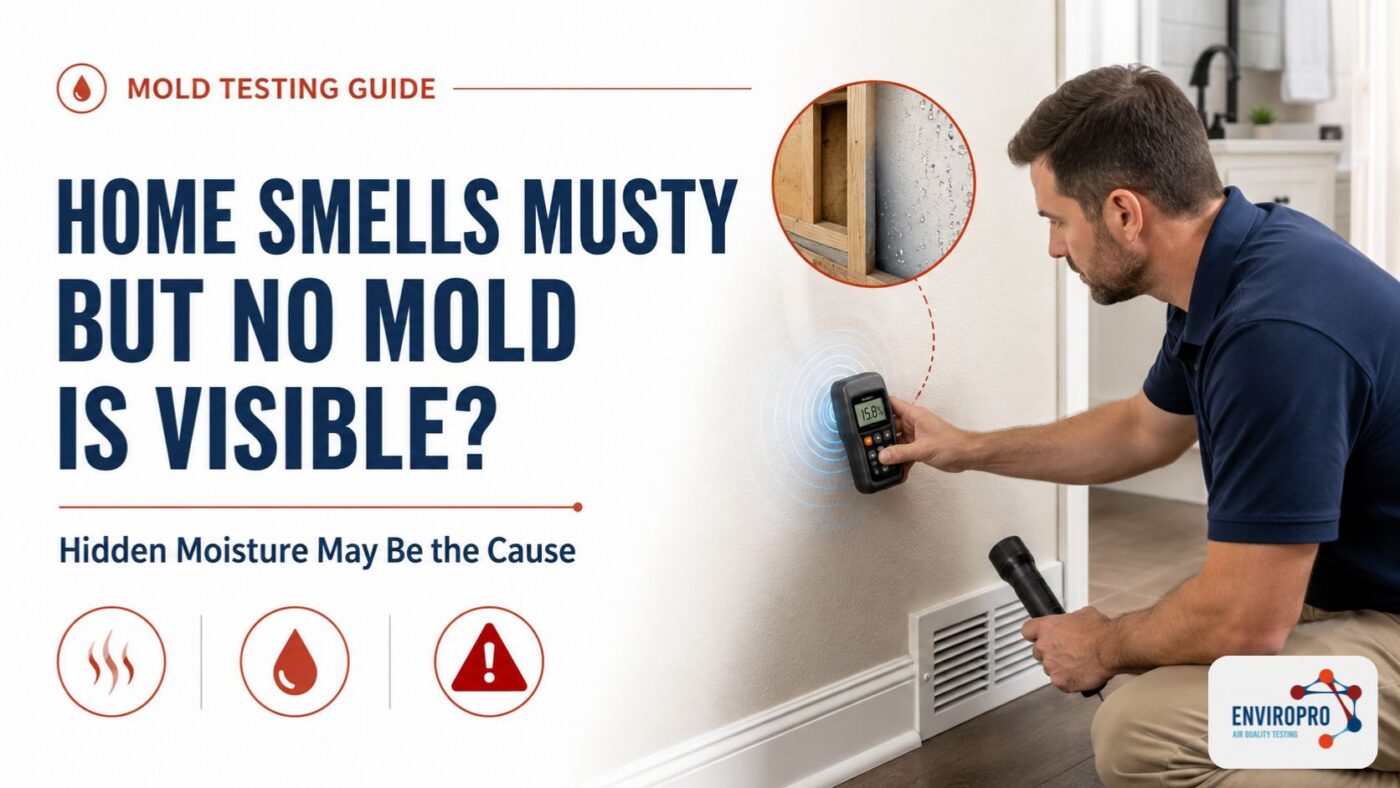
If your home smells musty but no mold is visible, the most likely cause is hidden moisture somewhere in the property. That moisture may be feeding hidden mold, mildew, bacteria, damp building materials, or stale air trapped in a poorly ventilated space. Sometimes the issue is not mold at all, but a leak, dirty HVAC component, wet carpet padding, drain buildup, or humidity problem.
A musty smell is not something to panic over, but it is worth taking seriously. The EPA explains that mold control starts with moisture control, and water-damaged areas should be dried quickly to help prevent mold growth.
What does a musty smell usually mean?
A musty odor is often described as damp, earthy, stale, or similar to wet cardboard. That smell can come from microbial activity, damp porous materials, or stagnant air.
Mold and bacteria can release odor-producing compounds as they grow. You may smell the problem before you can see it because mold does not always grow on open, visible surfaces.
Common odor sources include:
- Damp drywall
- Wet insulation
- Carpet padding
- Cabinet bases under sinks
- HVAC drain pans or coils
- Stored cardboard boxes
- Laundry areas
- Shower walls and bathroom corners
- Areas affected by old leaks
The CDC notes that mold can smell musty and that mold grows where moisture is present, including areas around leaks in roofs, windows, pipes, walls, or places affected by flooding.
In short: A musty smell is usually a moisture clue. It does not prove mold by itself, but it does mean the source should be found.
Why your home can smell musty even when you can’t see mold
The phrase home smells musty but no mold usually means one of three things is happening:
- Mold is growing somewhere hidden.
- Moisture is trapped in a material that is holding odor.
- Air is not moving well enough to dry the area.
Visible mold is only the part you can see. The source can be behind a wall, under flooring, inside an HVAC area, or beneath a cabinet.
In Las Vegas homes, this often happens after a slow plumbing leak, AC condensation issue, roof leak after a storm, bathroom ventilation problem, or water damage that looked dry on the surface but stayed damp inside building materials.
Why you may not see it
You may not see mold because it can grow:
- Behind baseboards
- On the back side of the drywall
- Under vinyl plank, laminate, or carpet
- Inside wall cavities
- Around plumbing penetrations
- Behind shower surrounds
- Inside cabinets
- Near HVAC air handlers or condensate lines
This is where moisture detection matters. A wall can look normal from the outside while the material behind it is still damp.
In short: No visible mold does not always mean no mold. It may mean the moisture source is hidden.
Common causes of a musty smell, but no visible mold
|
Possible cause |
What you may notice |
First thing to check |
When testing may help |
|
hidden mold |
Earthy smell in one room or near a wall |
Stains, soft drywall, warped trim |
When the odor persists, and the source is unclear |
|
Old water damage |
Smell returns after AC runs or when the room is closed |
Past leak areas, flooring, and cabinets |
When you need lab-backed confirmation |
|
Plumbing leak |
Odor under sink, near toilet, laundry room |
Supply lines, drain lines, and cabinet base |
When materials stay damp, or staining appears |
|
HVAC issue |
Smell from vents or only when the system runs |
Filter, drain pan, condensate line |
When indoor air may be affected |
|
High humidity |
Stale smell in bathrooms, closets, laundry areas |
Indoor humidity readings |
When moisture readings suggest a larger issue |
|
Damp carpet or padding |
Smell near floors, rugs, or pet areas |
Carpet edges and padding |
When odor remains after cleaning and drying |
|
Drain buildup |
Smell near sinks, showers, and the washer drain |
P-traps and drain openings |
Usually, plumbing/cleaning first, testing only if odor remains |
The CDC recommends keeping indoor humidity no higher than 50% and using air conditioning or dehumidifiers to help keep levels low.
In short: The smell may come from mold, but it may also come from moisture, HVAC, drains, or damp materials. The goal is to find the source before paying for the wrong fix.
Simple checks you can do before scheduling mold testing
Before calling for mold testing Las Vegas services, take a careful walk through the property. Do not tear open walls or pull up flooring unless you already know what you are dealing with.
Start here:
- Track where the smell is strongest.
Close interior doors for a few hours, then check each room. A stronger smell in one room gives you a starting point. - Check under sinks and around toilets.
Look for swelling, dark staining, soft cabinet floors, loose caulking, or a sour smell near plumbing. - Look near baseboards and flooring edges.
Warped trim, bubbling paint, lifted flooring, or discoloration can point to moisture behind the surface. - Pay attention when the AC turns on.
If the smell appears when air starts moving, the HVAC system, duct area, filter, drain pan, or nearby moisture source may be involved. - Check bathrooms and laundry areas.
Showers, tubs, washing machines, and dryer areas create moisture quickly if ventilation is weak. - Use a humidity monitor.
A small indoor hygrometer can show whether the air is staying too damp. This does not find hidden mold, but it can confirm conditions that support it. - Review recent water events.
A sink overflow, toilet leak, roof leak, AC drain backup, or water heater issue can leave moisture behind even after the visible water is gone.
Expert tip: If the odor is strongest near a wall, floor, ceiling, or vent, avoid spraying fragrance or running ozone machines to “cover it up.” Odor control without moisture control usually delays the real fix.
In short: Use your nose, eyes, and simple humidity checks first. If the smell stays or points to hidden moisture, bring in a professional.
When mold testing makes sense
Mold testing makes sense when you need evidence instead of assumptions. It is especially useful when there is a persistent odor, recent water damage, health-sensitive occupants, a real estate concern, or a need to compare indoor air conditions with outdoor mold levels.
Schedule professional testing when:
- You smell mold but cannot find the source.
- The odor returns after cleaning.
- There was a plumbing leak, a roof leak, or an AC drain issue.
- You are buying, selling, renting, or managing a property.
- A tenant or family member reports indoor air quality concerns.
- You need documentation after water damage.
- You need post-remediation verification testing after cleanup.
- You need to know whether indoor mold spore levels are elevated compared with outdoor levels.
There is also a time when testing may not be the first step. If you can clearly see a small mold area on a hard surface and the moisture source is obvious, cleanup and moisture repair may come first. The EPA says the cleanup approach depends partly on the size of the mold problem, and small areas may often be handled by the property owner when done safely.
The CDC also notes that mold sampling cannot predict whether a specific person will become sick, and there are no set national standards for acceptable amounts of different molds in a home. That is why testing should be used for environmental information, not as a medical diagnosis.
In short: Testing is helpful when the problem is hidden, disputed, recurring, or needs documentation. It should not be sold as a health diagnosis.
How professional mold inspectors find hidden moisture
A proper mold inspection Las Vegas should not be a glance around the room. The inspection should look for moisture patterns, odor sources, risk areas, and conditions that allow mold to grow.
At Enviropro Mold & Mycotoxin Testing, inspectors may use a mix of visual inspection, humidity readings, moisture meters, thermal imaging, air sampling, surface sampling, and lab analysis. The company also compares indoor and outdoor samples to help determine whether indoor mold spore levels are elevated.
Tools that may be used
Thermal imaging inspection
Thermal cameras can help locate temperature differences that may suggest hidden moisture behind walls or ceilings. They do not “see mold,” but they can help guide the inspection.
Moisture meter readings
Moisture meters help check whether drywall, flooring, trim, or other materials are holding moisture.
Humidity readings
Humidity readings show whether indoor conditions may support microbial growth.
Mold air testing
Air samples can measure airborne mold spores. This is useful when odor is present but visible growth is not.
Surface mold testing
Surface samples can identify mold on a specific material or suspicious area.
Certified lab analysis
Lab analysis can identify mold types and spore levels, then help explain what was found in plain language.
In short: Professional inspection is not about guessing. It combines site observations, moisture readings, sampling, and lab results.
Air testing vs surface testing: which one fits a musty odor?
Both mold air testing and surface mold testing can be useful, but they answer different questions.
|
Test type |
What it answers |
Good fit for |
Limitation |
|
mold air testing |
Are mold spores elevated in the indoor air? |
Musty odors, hidden mold concerns, and HVAC-related concerns |
It may not identify the exact hidden source by itself |
|
surface mold testing |
What is growing on this specific surface? |
Stains, suspicious spots, settled dust, visible residue |
It only represents the sampled area |
|
Indoor/outdoor comparison |
Are indoor spore levels unusual compared with outdoor air? |
Lab-backed indoor air quality review |
Outdoor levels can change with the weather and season |
|
Moisture inspection |
Where is moisture present? |
Leaks, water damage, and hidden damp areas |
Moisture does not always mean active mold |
For a home with a musty odor but no visible mold, air sampling plus moisture inspection is often more useful than surface testing alone. If there is a suspicious stain or residue, a surface sample may also make sense.
In short: Air testing checks the breathing zone. Surface testing checks a specific spot. Moisture readings help locate the reason the odor started.
What lab results can and cannot tell you
A detailed mold report can give useful information, but it should be explained honestly.
Lab-tested results can help show:
- Mold spore types detected
- Whether indoor levels are elevated compared with outdoor air
- Whether certain rooms show higher activity than others
- Whether moisture-related findings support a hidden growth concern
- Whether the cleanup may need follow-up verification
Lab results cannot honestly promise:
- That a property has “zero mold”
- That a person’s symptoms are caused by mold
- That a home is permanently safe from future mold
- That moisture will not return if the source is not fixed
This is why plain-language reporting matters. A useful report should help you understand what was sampled, why it was sampled, what the results suggest, and what the next step makes sense.
In short: Testing gives data. Good interpretation turns that data into a practical plan.
Why musty odors happen in Las Vegas homes
Las Vegas is dry outside, but indoor moisture problems still happen. Mold does not need a humid climate every day. It needs a damp material and enough time.
Common Las Vegas triggers include:
- AC condensation problems
- Slow plumbing leaks
- Water heater leaks
- Shower and bathroom ventilation issues
- Roof leaks after storms
- Wet flooring from appliance leaks
- Condensation around windows or in poorly ventilated rooms
- Water damage that was dried only on the surface
Because many Las Vegas homes rely heavily on air conditioning, odor patterns around vents deserve attention. If the smell gets stronger when the system runs, the source may be in the HVAC area or the air may be moving odor from another damp location.
The EPA advises not running an HVAC system if you know or suspect it is contaminated with mold because it could spread mold through the building.
In short: A desert climate lowers some risks, but it does not remove the risk of indoor moisture or hidden mold.
What to do if the smell keeps coming back
If the musty smell in house keeps returning, do not keep masking it with candles, sprays, or air fresheners. Those may change the smell for a few hours, but they do not dry wet materials or remove hidden growth.
Use this decision guide:
- If you find an active leak, call a plumber or qualified repair professional first.
- If the odor comes only from drains, clean and inspect the drain system first.
- If the smell appears when the AC runs, have the HVAC system and nearby moisture areas checked.
- If the smell is strongest near a wall, floor, cabinet, or ceiling, schedule moisture detection and inspection.
- If there was water damage, consider water damage mold inspection before closing walls, replacing flooring, or painting.
- If the cleanup was already completed, use post-remediation verification testing to check whether the work met the intended goal.
For property managers, landlords, and real estate professionals, testing can also create a clear written record. That matters when decisions need to be based on lab results rather than opinions.
In short: Find the water source, confirm whether mold is involved, then fix the right problem in the right order.
When black mold or mycotoxin testing may be relevant
A musty smell does not automatically mean black mold testing is needed. “Black mold” is often used casually for any dark-colored growth, but color alone does not identify the mold type.
Testing may be useful if there is visible dark growth, a history of water damage, elevated indoor spore concerns, or specific questions about mold type. Mycotoxin testing may be considered in more specialized cases where a property owner wants additional environmental information beyond standard mold spore testing.
Honest note: If the issue is a small visible patch caused by a simple leak, the priority is still moisture repair and safe cleanup. Testing should support decision-making, not replace basic moisture control.
In short: Do not assume every musty smell is black mold. Use testing when identification or documentation is actually needed.
Frequently Asked Questions
Your house may smell musty because moisture is trapped behind walls, under flooring, inside cabinets, near HVAC components, or in damp porous materials. Mold may be hidden, but the odor can also come from drains, wet carpet padding, poor ventilation, or old water damage.
Yes. Mold can grow in hidden spaces where you cannot see it. The smell may come from microbial activity, damp building materials, or mold spores moving through the air. A professional inspection can help determine whether the odor is linked to hidden mold.
You should consider mold testing if the odor is persistent, keeps returning, follows water damage, appears near vents, or cannot be traced to a simple source. Testing is also useful when you need documentation for a landlord, property manager, buyer, seller, or remediation follow-up.
Mold air testing checks airborne mold spores and is useful when mold may be hidden. Surface mold testing checks a specific spot, stain, or material. Many inspections use both when the situation calls for it.
Yes. Mold can grow indoors in Las Vegas when moisture is present from leaks, condensation, plumbing issues, roof damage, appliance leaks, or poor ventilation. Outdoor dryness does not prevent mold if indoor materials stay damp.
No. A musty smell does not prove black mold. Many mold types and moisture problems can create odors. Lab testing is the proper way to identify mold types when identification is needed.
No. Mold testing can provide environmental information about the property, but it cannot diagnose symptoms or prove that mold caused a health issue. If you have health concerns, speak with a qualified healthcare professional.
Don’t guess when your home smells musty, but no mold is visible
When your home smells musty, but no mold is visible, the smartest next step is to look for moisture first. The odor may be coming from hidden mold, old water damage, HVAC issues, drains, damp flooring, or poor ventilation.
If the smell keeps coming back, Enviropro Mold & Mycotoxin Testing can help property owners in Las Vegas get clear answers through professional mold inspection, mold testing, indoor air quality testing, moisture readings, air and surface sampling, and lab-tested reporting.
